Cultivist Conversations with Nick Doyle
4 May 2026
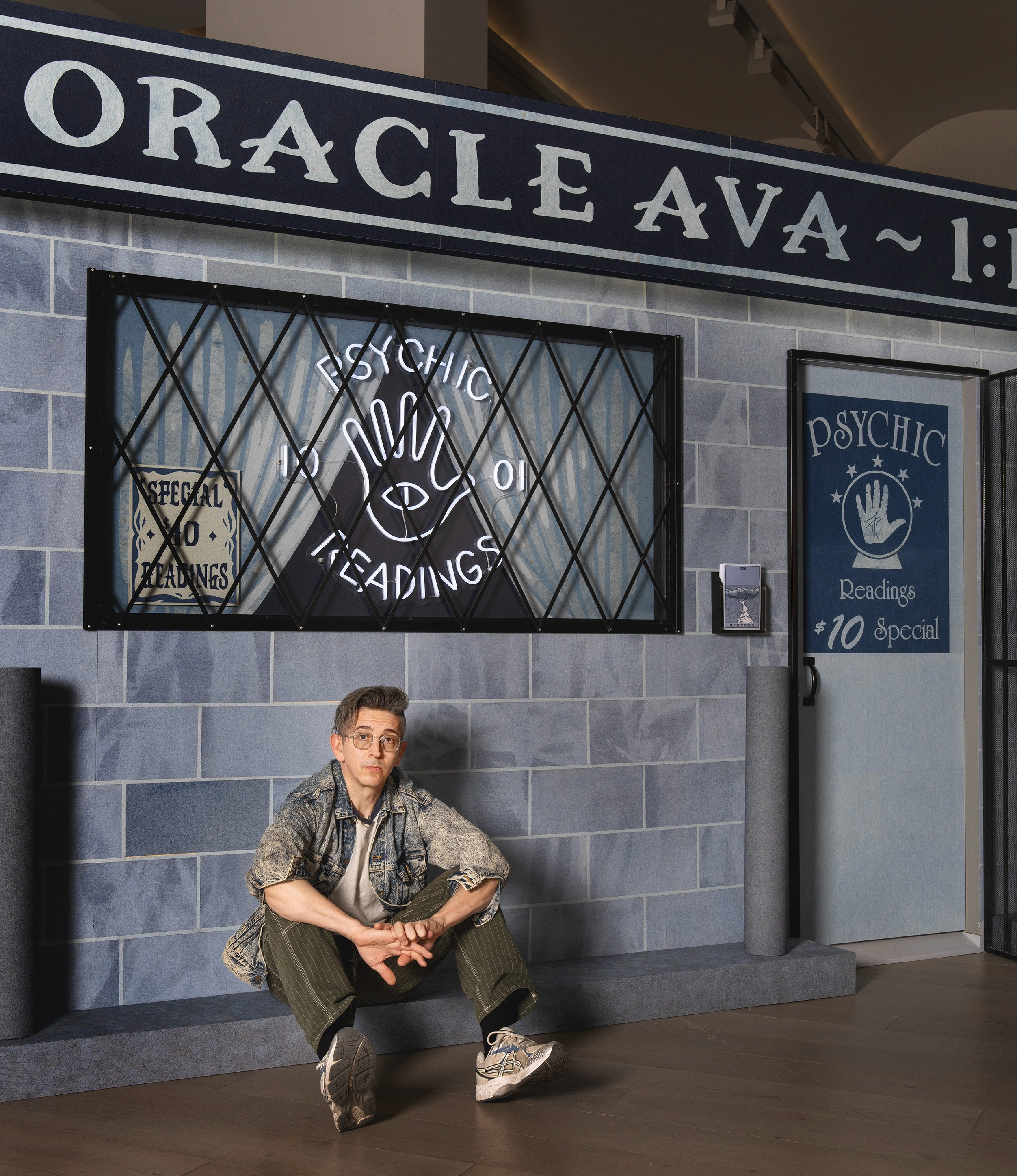
Portrait of Nick Doyle (2026) by Guillaume Ziccarelli, courtesy of the Artist and Perrotin
Nick Doyle’s “Collective Hallucinations” opened at Perrotin New York on April 24, so we sat down with him to discuss what led him to create this collection of works, using AI as a creative tool, and using absurdity to make a point.
On paper, this show is a departure from your usual work. You’ve gone from corporate culture and kink bars in Paris to the mythology of the American West. But both feel like they’re interrogating the same thing: the stories America sells itself. How do you see this show connecting to what came before, and where does it break away?
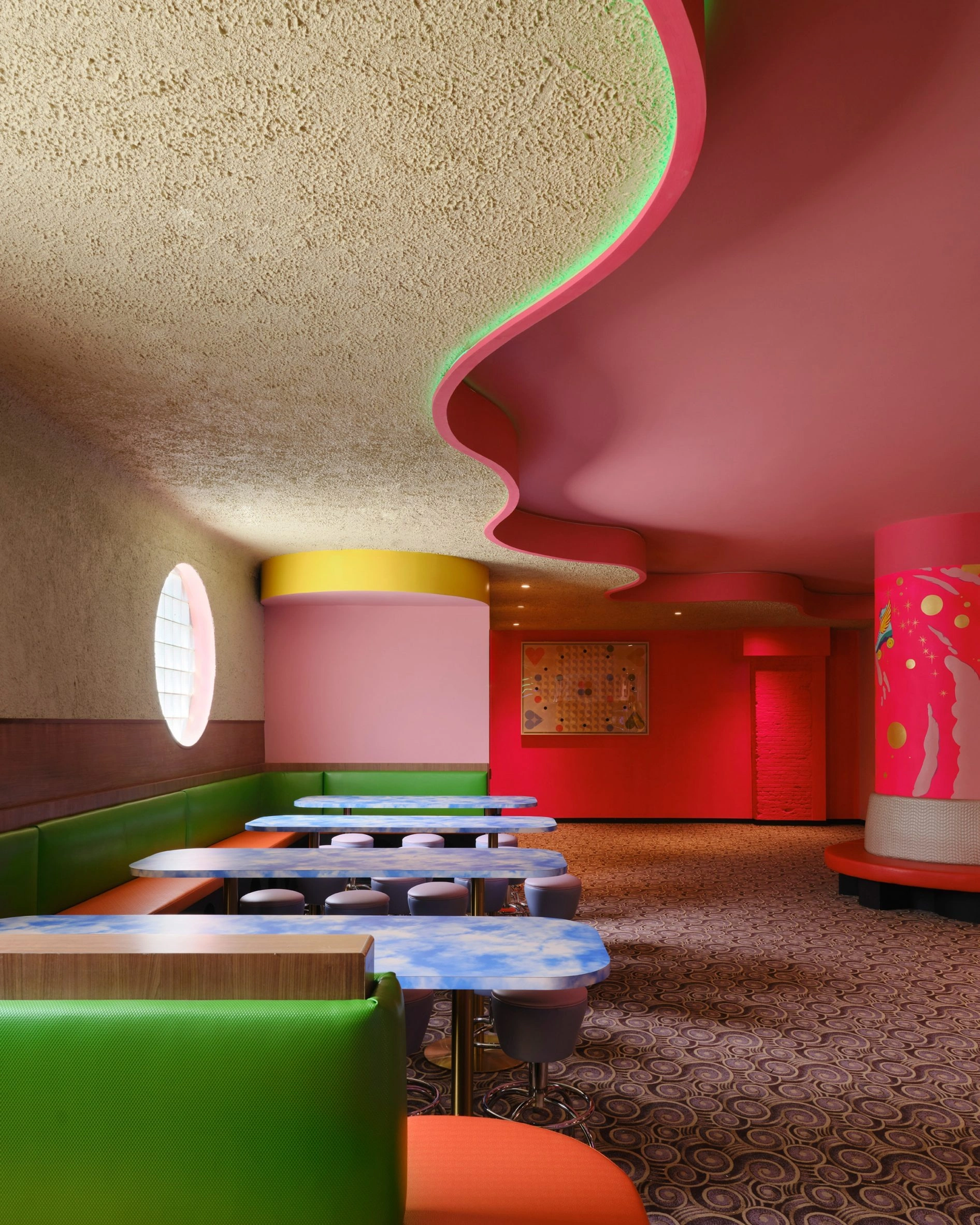
I think we are increasingly living in a reality where people are feeling more and more disconnected. I wanted a space that was playful and focuses on human connection in its physical form as a response to the dehumanizing aspects of corporate culture. Kink culture is truly about creating safe spaces for people to play and explore so it felt like a natural if not hilarious leap to make a Human Resources themed kink bar. With my current show this sense of disconnection is still present although taking on the image of the American west as its back drop. The American landscape has always symbolized the promise of a better future and has simultaneously paralleled technological advances that have given way to our country’s notions of progress. These ideas of western expansion have continued to resonate in Silicon Valley leading us into the new digital frontier of AI. And similar to the kink bar, I was looking for a way to physically connect to these ideas in a playful way. I created Oracle AVA 1:13 (below) as way physically embody and AI that people could interact with in a real time and space. She’s sassy, scary, and sometimes wildly insightful. But again I’m searching for some type of bridge that will bring people to reflect on what makes us human.
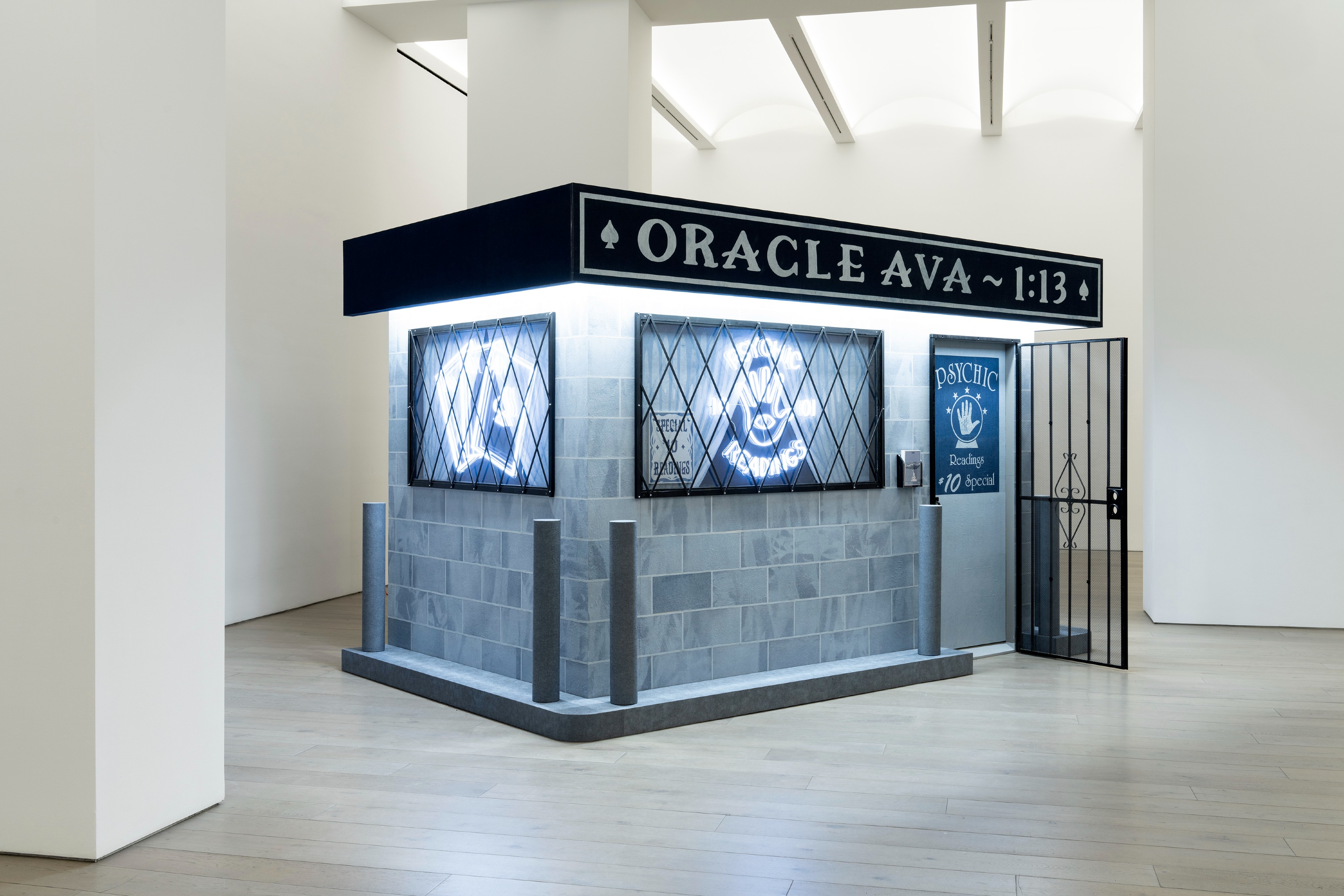
Nick Doyle “Mirror, Mirror” (2026) photography by Guillaume Ziccarelli, courtesy of the Artist and Perrotin
You grew up in Southern California, surrounded by the imagery this show draws from: the desert, the highways, the promise of something better just past the horizon. How much of “Collective Hallucinations” is you, reckoning with the place you come from? Is there a personal relationship to these symbols that goes beyond cultural critique?
It would be hard for me to separate these symbols from my Psyche. I have personal nostalgia for these spaces that parallels Americas nostalgia for them. I had a very idyllic upbringing in the foothills of the San Gabriel valley. I spent summer not wearing shoes, hiking, and swimming in waterfalls. The small town I grew up in was named Sierra Madre (Mother Mountain) and provided a calm oasis. I think a lot of my personal reckoning with these image parallels America’s reckoning with its own image. As I’ve grown older and understood americas colonial relationship to land, it complicates these symbols and in turn complicates what it means to presently be American.
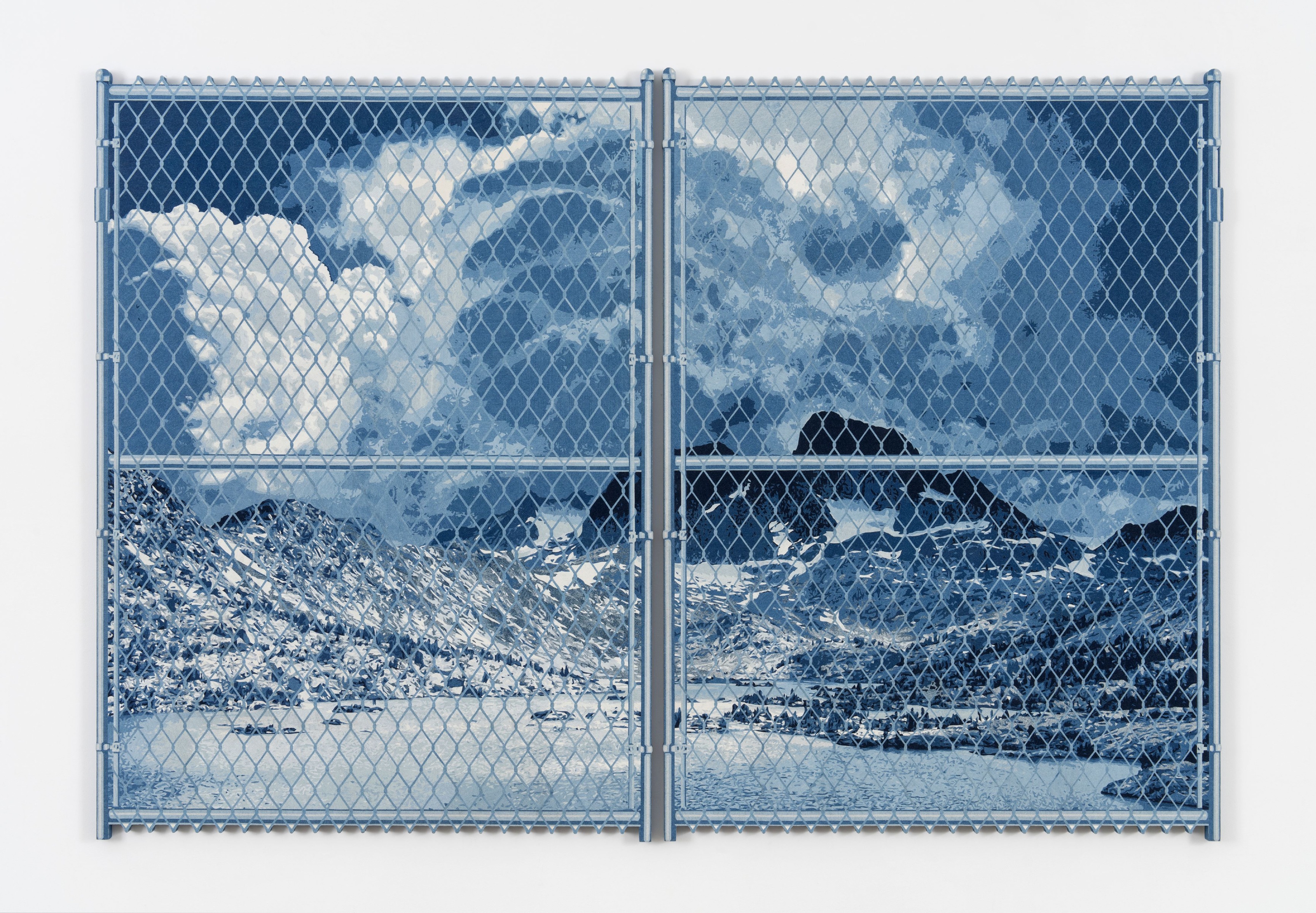
Nick Doyle “Perimeter” (2026) photography by Guillaume Ziccarelli, courtesy of the Artist and Perrotin
The denim wall works in this show feature aviators, cacti, car keys, bricks, etc. They’re simple but impactful, almost like icons. How do you decide what earns a place in the work?Is there a moment where a symbol clicks and you know it belongs, or is it more of a process of elimination?
Well sometimes I will hold an image in my mind for years before they become artworks. I’m an avid collector of images. I take a lot of black and white photos with an old film camera as well as collect images from the internet. Sometimes I come across an image and get very excited because it really resonates with me but for some reason it doesn’t quite work yet. Cut to years later when I find its the perfect fit for an idea I’m really excited about. The process is really intuitive and I have noticed that my intuitive mind is much further ahead than I am.
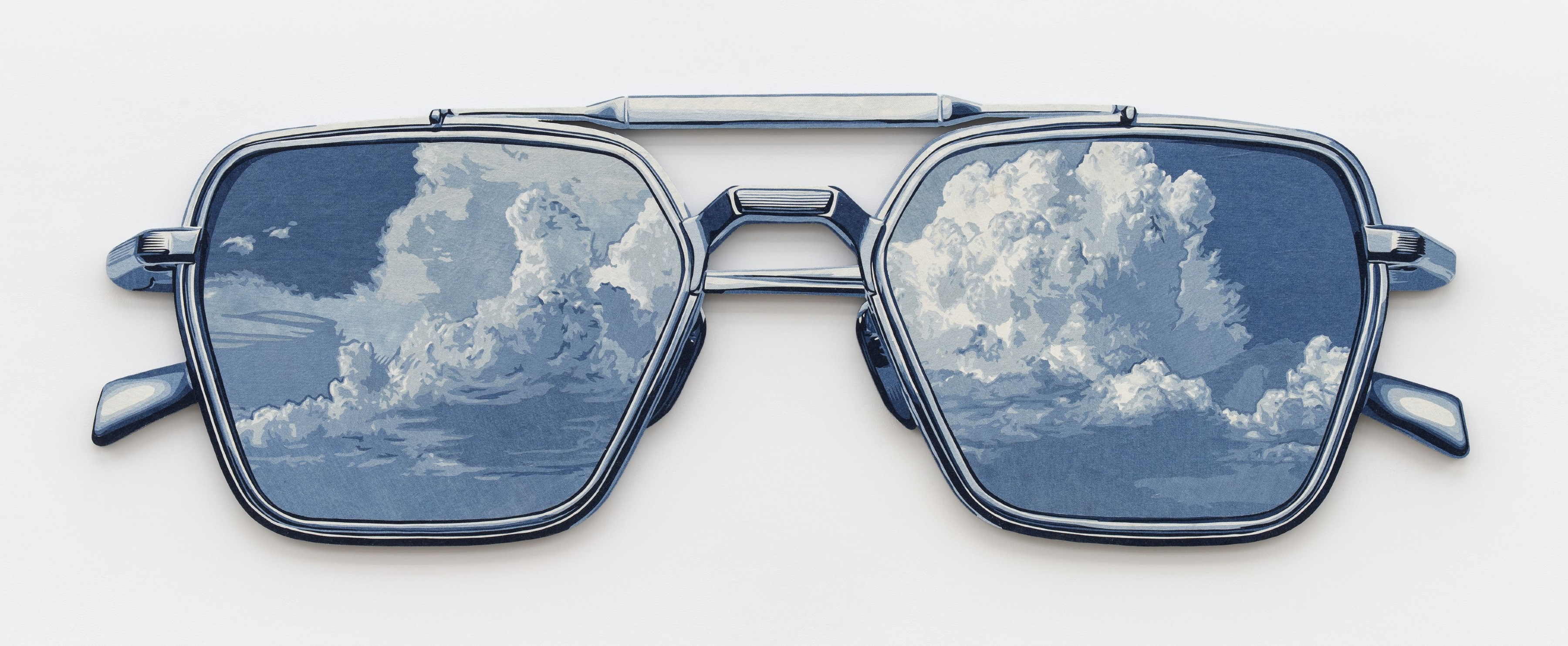
Nick Doyle “First Come the Dreamers” (2026) photography by Guillaume Ziccarelli, courtesy of the Artist and Perrotin
“Mirror, Mirror” is your first experiment with AI, which feels like a pretty significant turn for someone whose practice is so rooted in handcraft and material. How did the idea for an AI psychic come about, and what surprised you about working with a medium that’s essentially the opposite of cutting and collaging denim?
I was reading a history of California and thinking about how America has always been promoting this idea of “future”. It’s the cornerstone of how the west has been financed. Currently, Americas financial future is completely tied into the promise of an AI revolution. I think my brain thought an AI Psychic was a logical conclusion. A lot of people are worried about the future and what this all means for humanity, spiritually and economically. I tend to think with not only a collage sensibility but with a construction sensibility. I like to break things apart and then reconstruct them, whether that be a concept, an image or a medium. So I see AI as just another form to play with. Like an X-acto knife or a paintbrush.
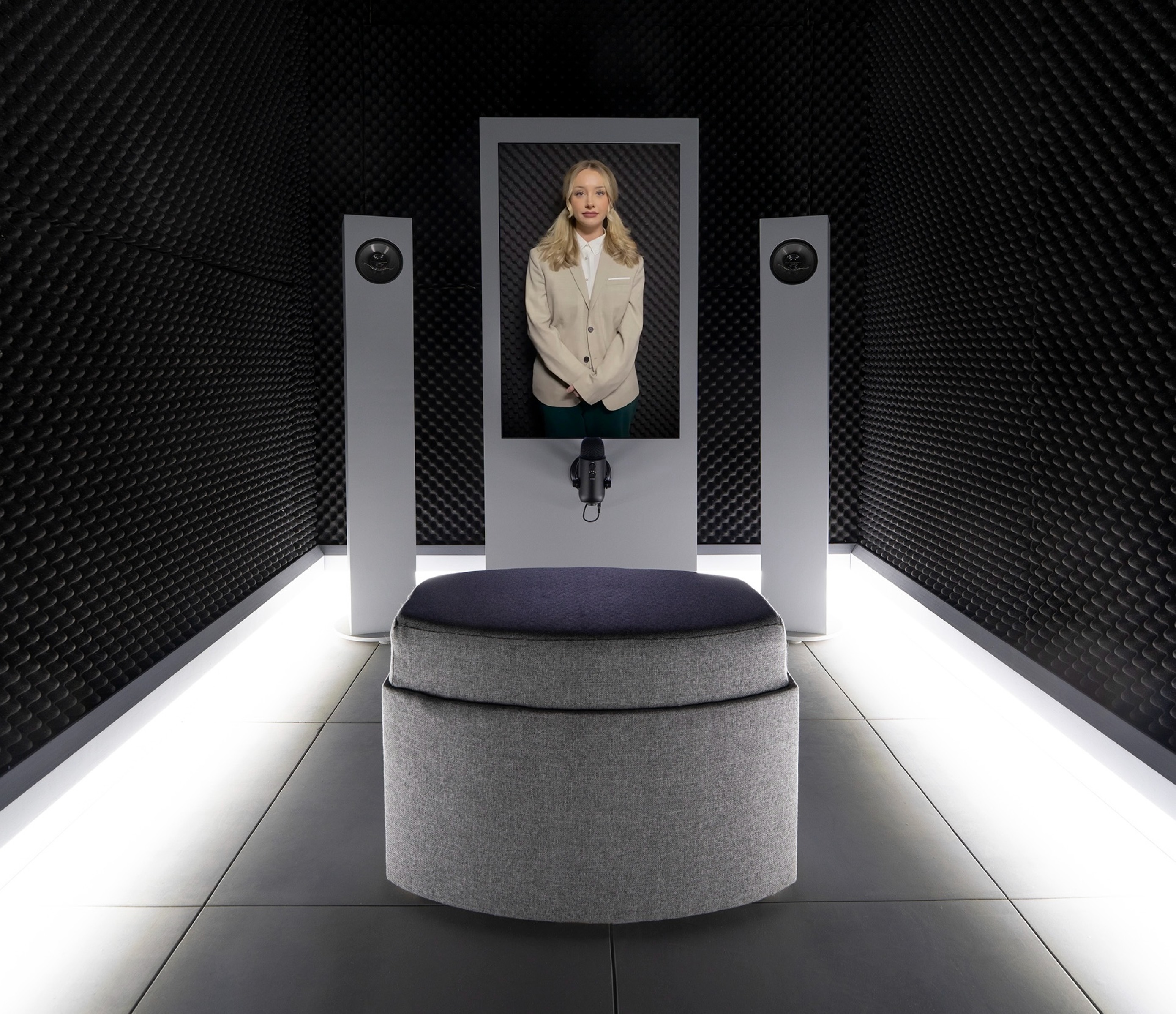
Nick Doyle “Mirror, Mirror” Interior (2026) photography by Guillaume Ziccarelli, courtesy of the Artist and Perrotin
Ava, the AI avatar inside “Mirror, Mirror,”(above) is described as a “diva oracle with a twist.” She’s sassy, intrusive, and refuses to flatter. You’ve said in the past that humor and absurdity are essential to how you communicate ideas. What role does Ava’s personality play in what you’re trying to say about AI and the way it mirrors back our own desires?
I think of it like we’re playing God a bit. We’re attempting to play the role of creator and generate an equivalent if not higher intelligence. I think there’s a hubris to it as well as a certain level of vanity to the process. But also something that is having ecological, financial and social consequences in real time. Which is terrifying. I based AVA off of Cher from the movie Clueless as way to deliver these ideas in a humorous way that feels approachable and less overwhelming.
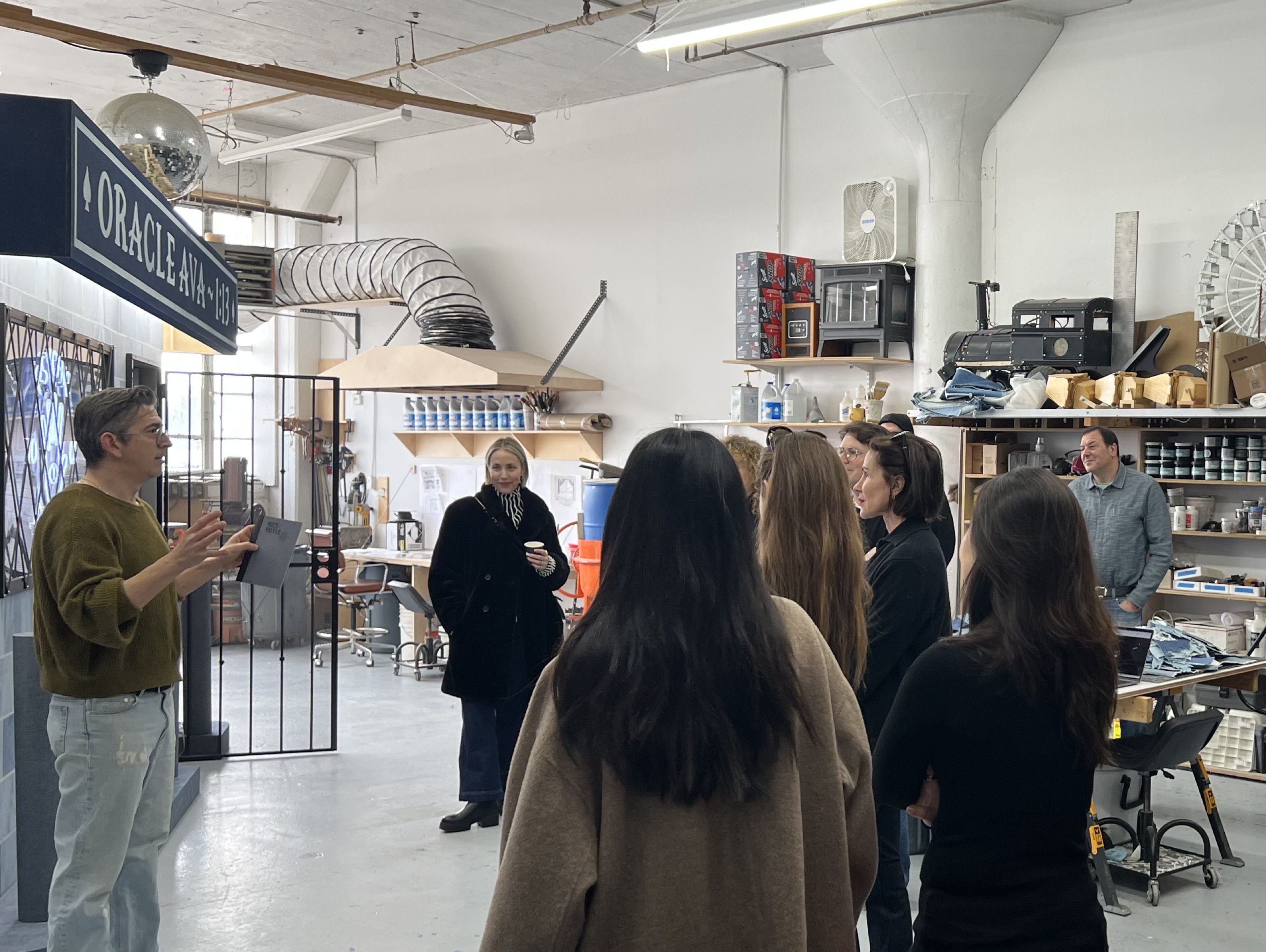
Nick Doyle giving a tour of his Brooklyn studio to Cultivist Members
You’ve been in Brooklyn for close to two decades now, but this show feels like a homecoming of sorts, at least thematically. After spending several bodies of work examining East Coast corporate culture and masculinity, what made this the right moment to look back toward the West?
I think we’re experiencing a dramatic shift in the West. Our country is socially, politically and economically divided. In my lifetime, the image the rest of the world has of America has changed, and not for the better. There are cracks in our foundation that need to be addressed and we can no longer rely on what we as a nation have taken for granted. It’s not really a question of what the American dream has become but when we are going to wake up to the reality.
“Collective Hallucinations” by Nick Doyle is open until 30 May, 2026 at Perrotin New York, 130 Orchard Street, New York, NY 10002. They’re open Tuesday - Saturday from 10am to 6pm.
Did you enjoy this interview? Want to hear more from Nick Doyle? Check out our Saturday in Bushwick with Nick Doyle here!