World Art Day: A Message to the Future, From Everywhere
15 Apr 2026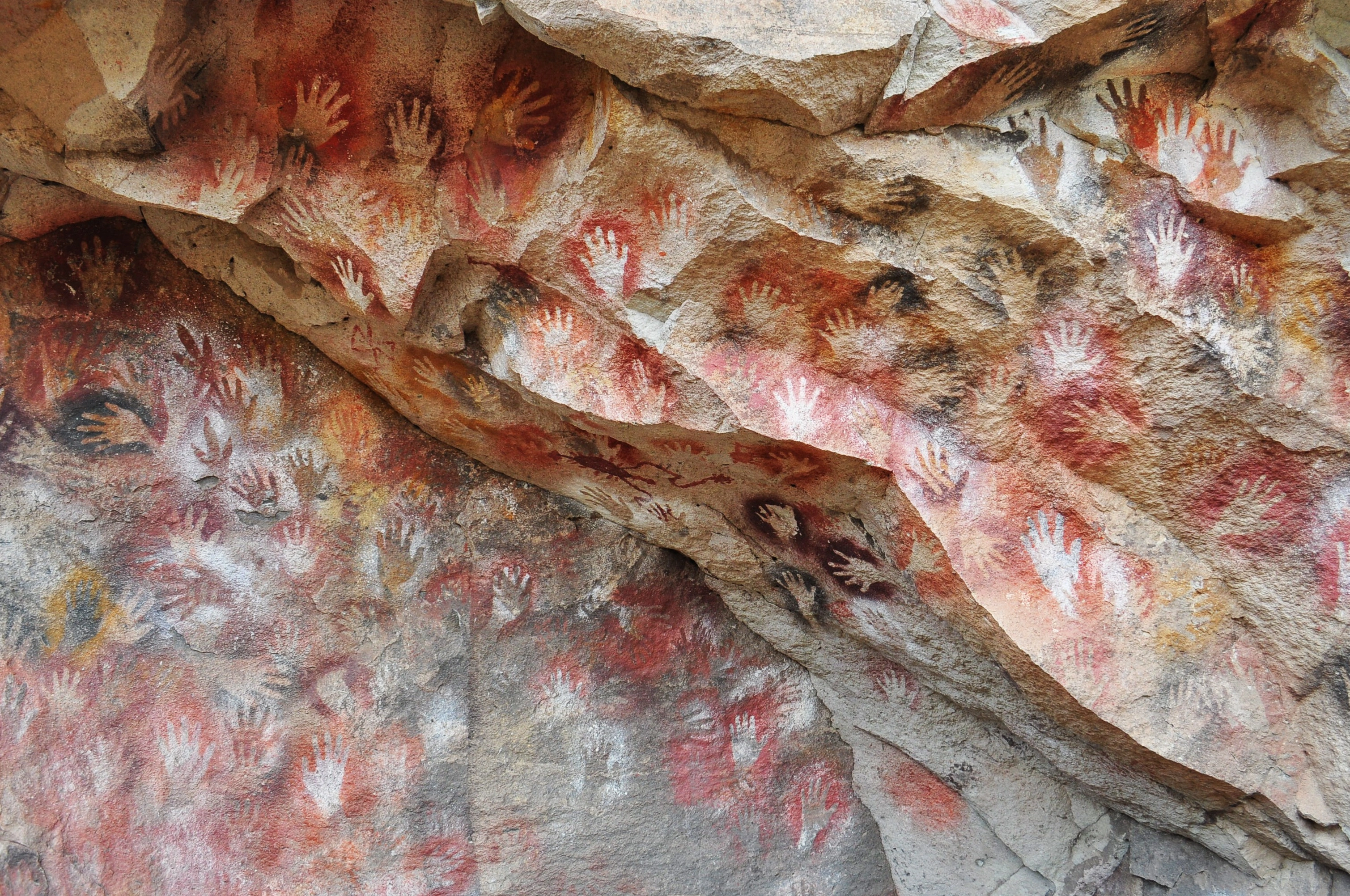
April 15 is World Art Day, and it is not an accident that it lands on Leonardo da Vinci’s birthday. UNESCO’s International Association of Art chose the date in 2011 precisely because Leonardo stands as a kind of shorthand for what the holiday is meant to defend. Curiosity without borders. Art as a form of thinking. The idea that creative expression belongs to everyone, everywhere, and deserves the same protection we give to language, science, and heritage. The day exists to remind governments, schools, and the rest of us that art is not just decoration. It is how a species works out what it means to be here.
So we went looking. Seven continents, seven works, across every gender, genre, generation, and medium we could fit. Cave painting and contemporary film. Manga and bonded marble. A woman in her seventies and an illustrator mid-career. Stone, snow, oil, ink, cotton, and digital brushes. Here is what we found.
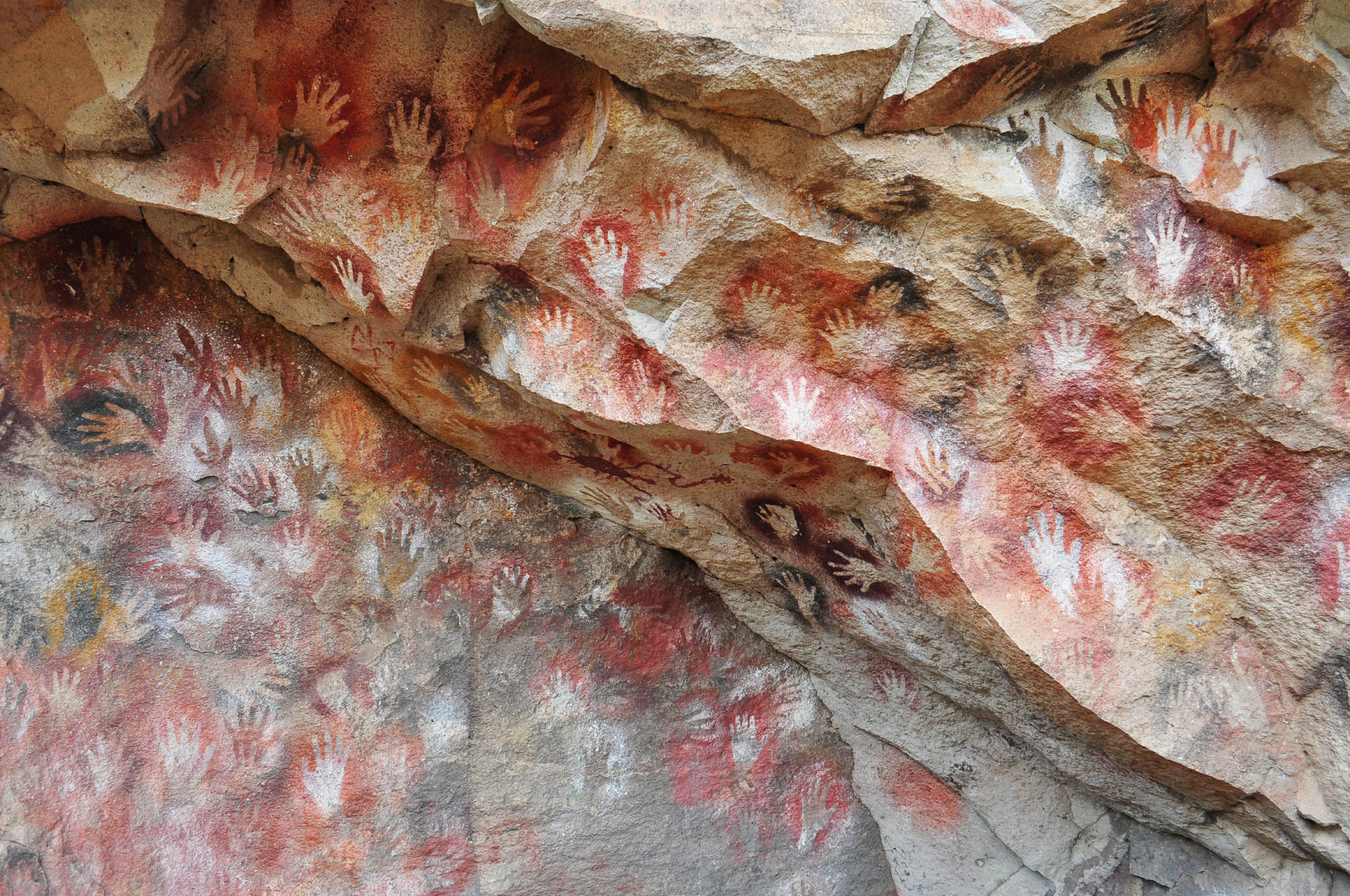
Rocío Lator ”Cueva de las Manos” (2013) Courtesy of the Photographer
South America | Argentina, “Cave of the Hands”
Indigenous Peoples of South America - Deep in the Pinturas River Canyon in Patagonia, there is a cave. Inside the craggy cliff are more than two thousand stenciled hands, painted in a variety of materials and minerals, layered in so many passes that the rock itself becomes a manuscript. The oldest marks date to around 7,300 BCE. The youngest, around 700 AD. That’s eight thousand years of people walking into the same cave and deciding to leave the same gesture.
Most of the markings are left hands, which means most of the painters were right-handed, holding a bone pipe and blowing pigment across their own skin. Some are missing fingers. Scholars still argue about whether that means sign language, ritual, disease, or something we will never recover. What you can say for certain is that generations of people found and returned to this site and each time they came back they added themselves to the wall. Not a signature. Not a name. Just the outline of a palm pressed against the rock and the quiet, stubborn insistence of presence. A message to the future that they were here, that they had bodies, and that their bodies mattered. If you want to understand why World Art Day exists, start here. This is the moment the impulse shows up, before there is a word for it.
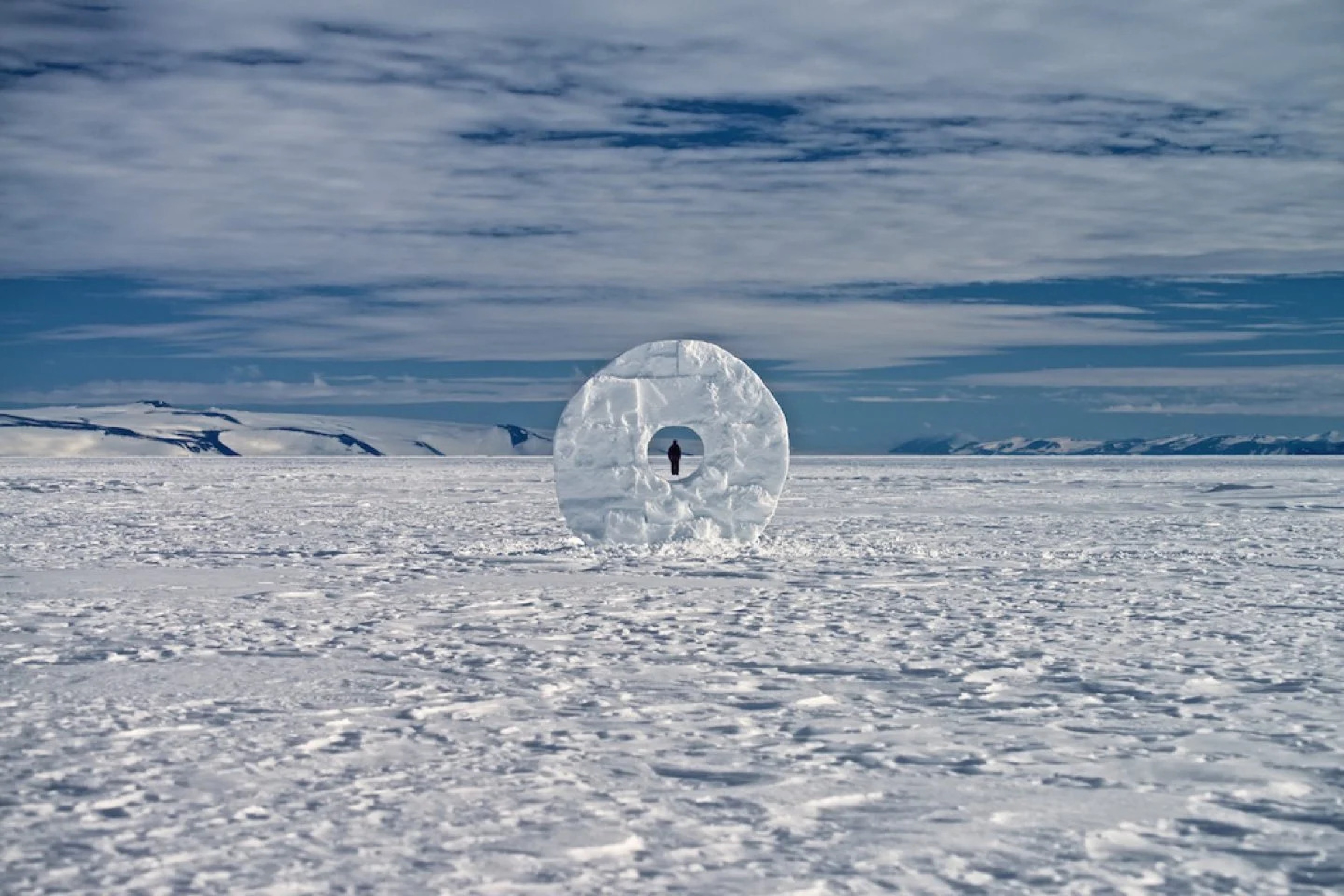
Martin Hill & Philippa Jones “Anthropocene” (2014) Courtesy of the Artist
Antarctica | Ross Ice Shelf, “Anthropocene”
Martin Hill, Philippa Jones - In 2014, Antarctica New Zealand invited Hill and Jones to Scott Base to make the tenth sculpture in their ongoing Fine Line project, a global series of ephemeral land artworks that emulate the circular design of nature itself. On the Ross Ice Shelf, they cut and stacked snow blocks into a standing ring roughly 1,800mm across, framing a solitary figure against an endless white horizon. They photographed it. Then they left it to the weather. The photograph is all that remains.
Hill and Jones have been working this way since 1994, building and documenting temporary sculptures that return to the landscape they came from. The work is sometimes called environmental art, but that undersells it. What they are actually making is an argument about time. Every piece is designed to disappear, which makes the photograph the real object, and the real object, in turn, a record of a moment when two humans went to the most remote place on Earth and, instead of trying to leave something permanent, made something the ice would erase. Anthropocene takes its title from the current geological epoch, the one we named after ourselves. The ring is a doorway. You stand inside it, and the planet stands outside.
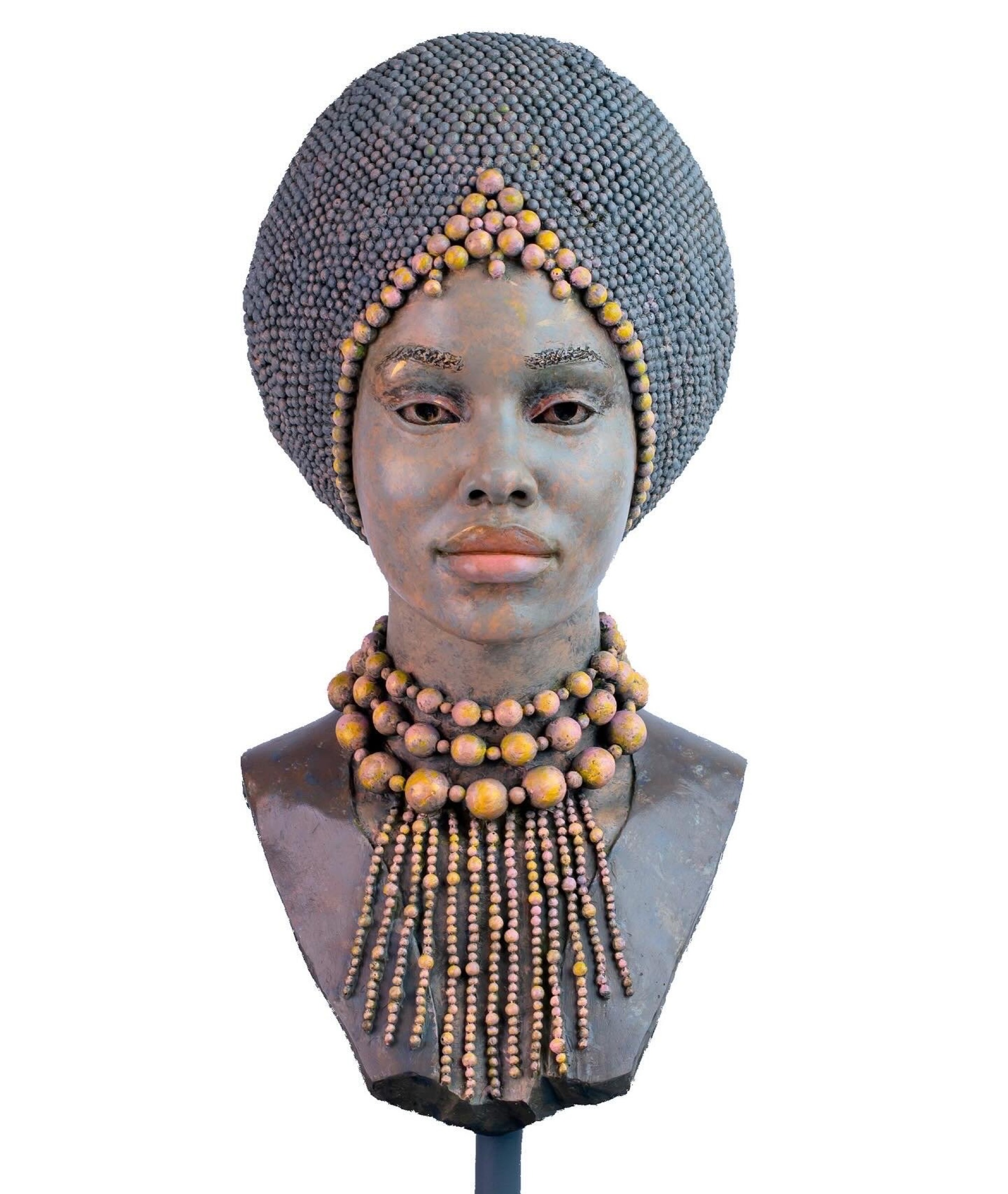
Ejiro Fenegal “Purity” (2025) courtesy of the artist and Mitochondria Gallery
Africa | Nigeria, “Purity”
Ejiro Fenegal - Born in 1991 in Ughelli, Delta State, Fenegal graduated from Yaba College of Technology in Lagos in 2019 and now works out of a studio in the city. Her practice draws directly on the sculptural traditions of the Urhobo people of the Niger Delta, a lineage that scholars trace back to the thirteenth century and that lives today in collections at the Smithsonian and the Metropolitan Museum of Art. The Urhobo worked in wood, clay, and bronze. Ejiro Fenegal works in bonded marble, a material she treats as a metaphor as much as a medium. Strength, resilience, and continuity across generations.
What sets her apart is where she points the tradition. Where earlier Urhobo sculpture focused on ritual archetypes and ancestral figures, Fenegal places contemporary African women at the center of her practice, modeling busts and torsos from live muses whose names and stories stay attached to the finished work. She has said that “every woman is worthy of being cast in stone,” and her exhibition Makers of Legacy (2025), at Houston’s Mitochondria Gallery, organizes itself around that conviction. Maiden, mother, matriarch. Labor, wisdom, authority. In an art world that has spent too long historicizing African sculpture as artifact, Fenegal insists on the present tense. These women are not only relics of their ancestors. They are here, now, and they deserve to take up the space they inhabit.
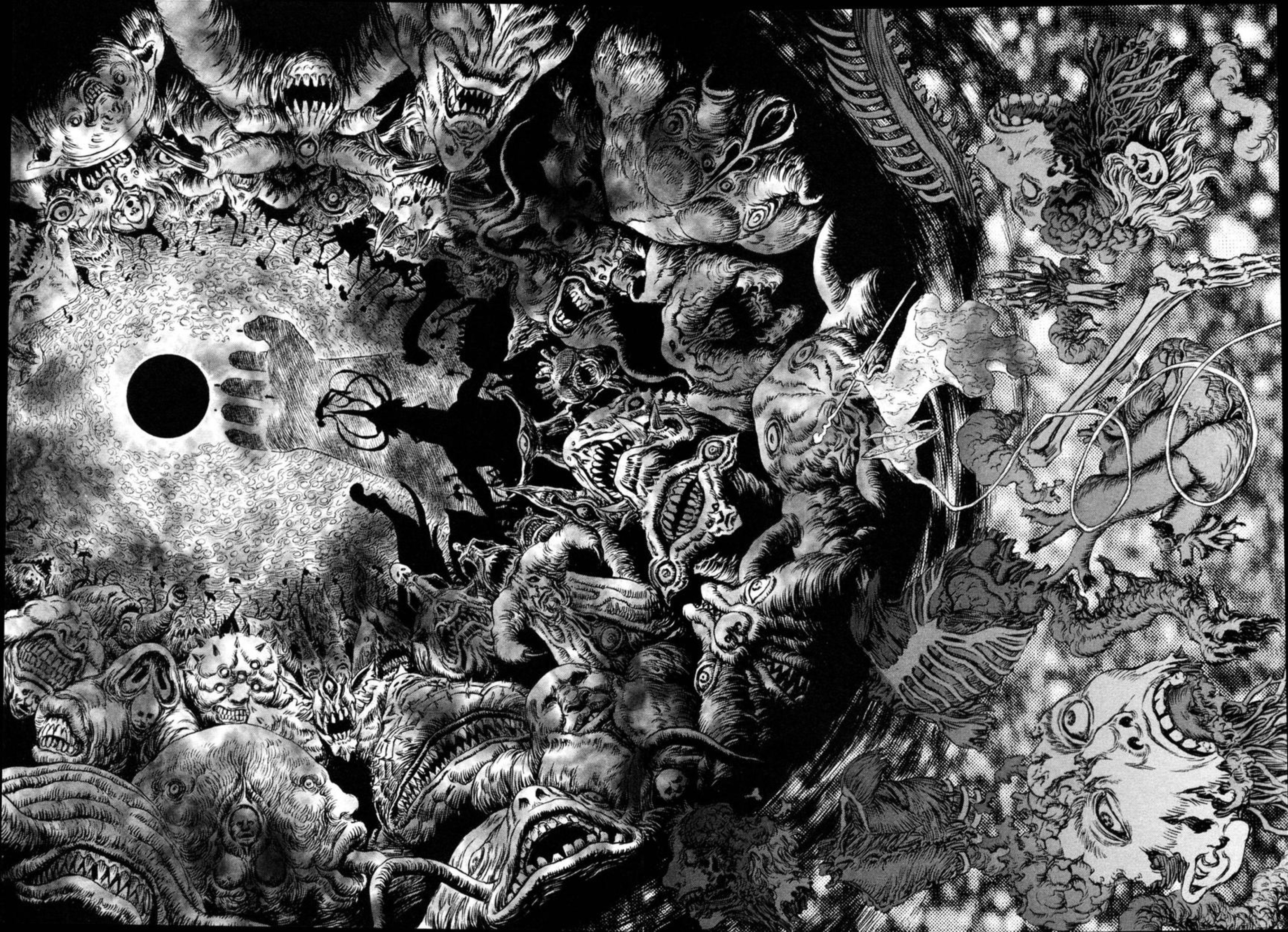
Kentaro Miura “Eclipse” from Berserk Volume 27. Courtesy of Hakusensha and the artist.
Asia | Japan, “The Eclipse”
Kentaro Miura - Berserk is not hanging in a museum, and that is part of the point. Miura began serializing his dark fantasy epic in 1989, and by the time of his passing in 2021 he had produced forty-one volumes of some of the most obsessively detailed ink drawing in the history of the medium. The world-building is total. A single two-page spread can contain the entirety of the climax, reminiscent of Raphael’s grand cartoons. “The Eclipse”, the climactic sequence of the manga’s Golden Age arc, is where the realism curdles into something closer to Bosch, and the line between fiction and nightmare collapses.
At the heart of this ongoing work is Guts, a mercenary born into cruelty who refuses to stop swinging, and Griffith, the charismatic leader whose dream of his own kingdom eventually costs him everything human. Miura’s real subject, underneath the swordplay and the demons, is fate. Whether a person can push back against an outcome that seems already written. Guts’ entire argument is that the trudge itself is the point. That fighting through a life of hardship and solitude has value even when no victory is coming, because the act of refusing to surrender is its own kind of meaning. Miura died before finishing the story, which gives the whole project a second, unintended layer of the same theme. Comics are art. He made the case louder than almost anyone.
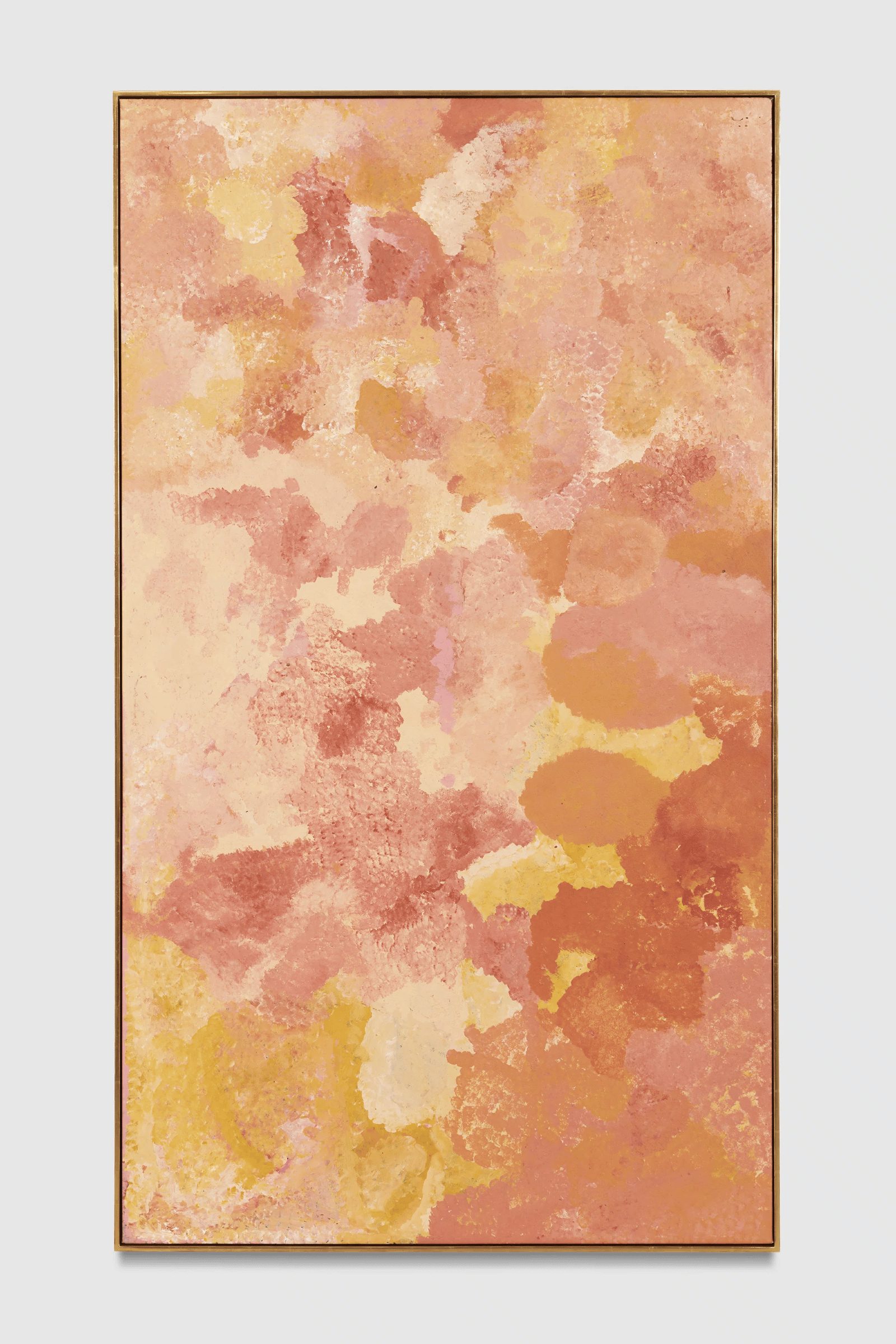
Emily Kam Kngwarray “Untitled”(1992)© Emily Kam Kngwarray, Copyright Agency, courtesy of Pace Gallery
Australia | Alhalker, “Untitled”
Emily Kam Kngwarray - Kngwarray was an Anmatyerr elder from Alhalker, a remote desert region of Australia’s Northern Territory. She was born around 1914 and did not pick up a canvas until she was in her late seventies, after decades of working in batik, a dyeing technique using wax resist. Once she started painting, she did not stop. In the last eight years of her life she produced an estimated three thousand works, a pace that’s nearly impossible to square with the scale and ambition of what she was creating.
Her practice is rooted in the Dreaming, the Anmatyerr framework that structures the relationships between people, ancestors, descendants, the land, and the spirits that animate it. She painted her Country. Not a picture of it, but the thing itself: its history, its vegetation, its ceremonial life, the root systems of the pencil yam whose seeds gave Kngwarray her own skin name, Kam. Her layered brushstrokes and dabs of saturated color read to a Western eye as abstraction, and to the people who know how to read them, as a map. She was represented posthumously at the 47th Venice Biennale in 1997, and in 2025 Tate Modern staged a major retrospective that confirmed what the Australian art world has known for decades. She is one of the most important artists the continent has ever produced. She started late, and she painted until the end, but what she made continues to live on.
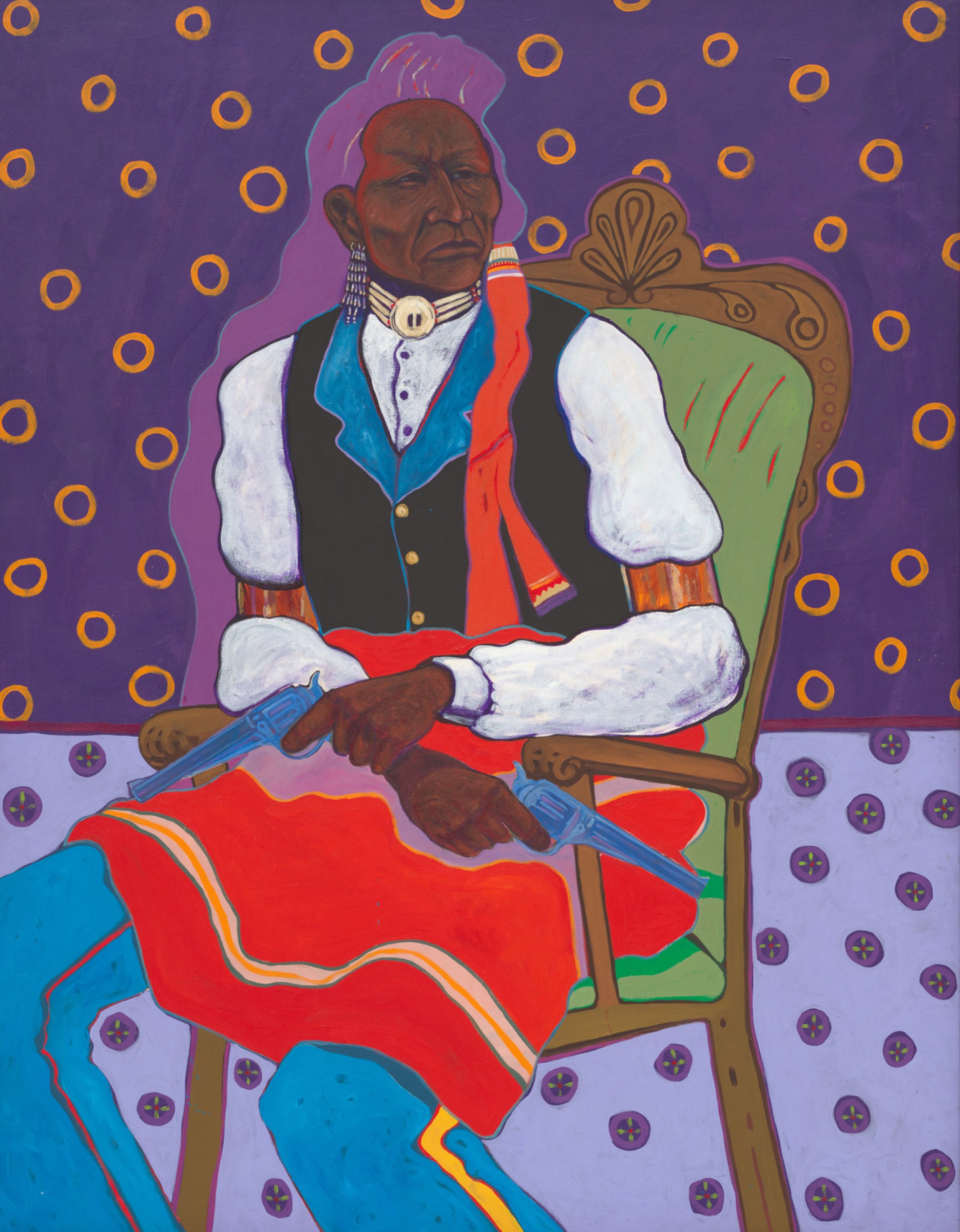
T.C. Cannon “Two Guns Arikara” (1973/77) Courtesy of the Museum of Modern Art
North America | Caddo Nation, “Two Guns Arikara”
T.C. Cannon - Tommy Wayne Cannon was born in 1946 in Oklahoma, raised by a Kiowa father and a Caddo mother, and educated at the Institute of American Indian Arts in Santa Fe during the years when IAIA’s first generation of students was actively tearing up the rules of what Native art was allowed to look like. He enlisted in 1966, served two years in Vietnam with the 101st Airborne, earned two Bronze Stars during the Tet Offensive, and came home quieter, more serious, and more determined. He passed in 1978, killed in a car accident in Santa Fe at thirty-one, with roughly fifty paintings, a stack of poems and songs, and a reputation that had just started to catch up to him.
Two Guns Arikara, painted between 1974 and 1977, is Cannon at full strength. An imagined Native man in U.S. military scout uniform, sits in a green Victorian armchair, wearing First Nations adornments. A bold red blanket across his lap, two bright-blue pistols resting in his hands, and Klimt-like gold rings circling behind him on a deep purple field. Cannon pulled from Van Gogh and Matisse as openly as he pulled from Kiowa and Caddo tradition, and he refused every binary he was handed. Native and non-Native. Traditional and contemporary. Warrior and colonizer. His curator Karen Kramer once put it this way: Cannon was averse to simple lines and engaged in the space in between. He believed people could understand his work because of shared histories, or shared humanity. He wanted to be known as “a good artist, not a good Indian artist” said a friend of his, Michael Lord. He was more than a “good artist”, and his work is still proving it.
https://www.youtube.com/watch?v=oJ32EasjyFI
Kathryn Ferguson “Nothing Compares” (2022) courtesy of Tara Films and Showtime.
Europe | Northern Ireland, “Nothing Compares”
Kathryn Ferguson - Ferguson is a Belfast-born filmmaker, and Nothing Compares, her 2022 documentary feature, is the most recent work on this list and arguably the most contested subject. The film is a portrait of Sinéad O’Connor across the years 1987 to 1993, the period when her iconoclasm collided with the pop mainstream and the mainstream blinked first. It premiered at Sundance in January 2022, won Best Documentary at the British Independent Film Awards that December, and sits at a 99 percent score on Rotten Tomatoes. Critics called it the most potent film about a woman in the music industry since Amy.
What Ferguson actually does, though, is bigger than a music documentary. She makes the case that O’Connor was right, about the Catholic Church, about the treatment of women in the industry, about the cost of speaking clearly in a culture that prefers its women ambiguous. And she makes it through a contemporary feminist lens, using archival footage and the voices of women O’Connor influenced, rather than the usual parade of male talking heads explaining the subject back to the audience. It is art as biography, as correction, and as the long patient work of restoring a reputation the world was in a hurry to flatten. Film belongs on a list of world art because film is where a lot of the cultural argument happens now. Kathryn Ferguson’s film is where one of the important arguments got settled.
Why This, Why Today?
World Art Day exists because UNESCO wanted a date on the calendar to remind the world that creative expression is a shared human inheritance, not a luxury good. Fair enough. But the more interesting argument is the one the works themselves make.
A cave in Patagonia, a manga from Chiba, and a documentary from Belfast are doing versions of the same thing across eight thousand years, seven continents, and every medium our species has ever invented. Marking presence. Making meaning. Saying we were here, and this is what it looked like from where we stood. Seven continents is a conceit. The impulse is universal.
Happy World Art Day from The Cultivist. Wherever you are on the map, go see something today.