Masterpiece Spotlight: Lee Krasner’s 'Combat'
28 Aug 2026
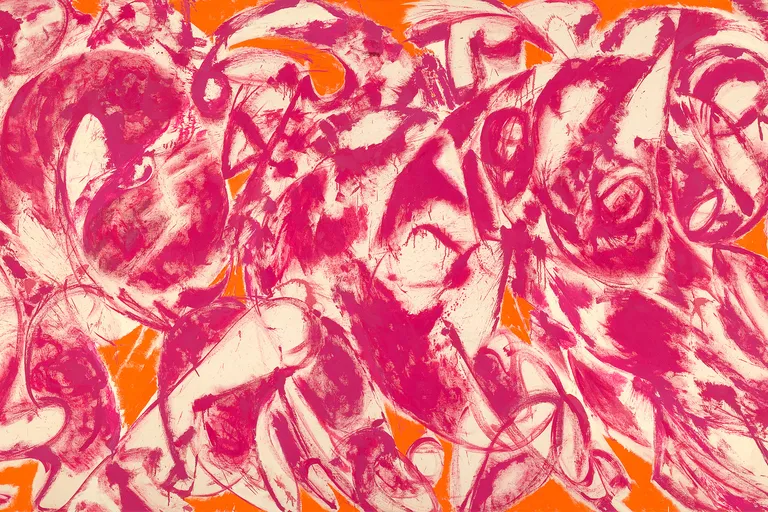
Lee Krasner’s Combat does not ease you in. Its hot pinks and blazing oranges arrive at full volume, while lines collide, loop and recoil across the canvas. Forms flicker into view before dissolving back into the movement, creating a painting that feels less observed than encountered.
Stay with it, though, and the apparent disorder begins to settle into something more deliberate.
Painted in 1965, Combat stretched more than four metres across and belongs to a period when colour returned to Krasner’s work with full force. After several years working largely in umber, black and white, she moved towards the vivid pinks, oranges and reds that dominate this canvas. The result is one of the most energetic paintings of her career.
The title suggests confrontation, but Krasner makes it strangely seductive. Deep crimson pushes against almost fluorescent pink, broad strokes meet loops and scratches, and forms seem to tangle before separating again.
Nothing stays still for very long.
An artist in constant reinvention
Krasner spent much of her career resisting the idea of a single signature style, moving between geometric abstraction, tightly packed Little Images, collage, monochrome painting and intense colour.
That restlessness is part of what makes Combat so compelling. Rather than settling into familiar visual language, Krasner repeatedly dismantled it and began again.
Scale became increasingly important too. After Jackson Pollock's death in 1956, Krasner began using the larger barn studio at their home in Springs, Long Island, giving her room to work on canvases that demanded the movement of her entire body.
Combat takes that freedom almost to its limit.

Lee Krasner in her studio in the Barn Springs 1962. Photo Credits: Hans Namuth
At 410 centimetres wide, photographs struggle to communicate just how imposing the painting is. Seen in person,the canvas extends beyond an easy field of vision, forcing you to move along it as Krasner’s gestures pull the eye from one side to the other.
It feels less like an image and more like an environment.
Krasner once described her work as deeply biographical, but Combat resists any neat explanation. There is struggle here, certainly, but also pleasure, confidence and freedom. Pink and orange do not simply fight for space; they energise one another. Gesture battles structure, and control slips in and out of spontaneity.
For an artist who continually refused to repeat herself, the instability feels fitting.
See Combat in New York this autumn
This October, Combat travels to New York for Krasner and Pollock: Past Continuous at The Metropolitan Museum of Art.
Opening 4 October 2026, the exhibition brings together more than 120 works, tracing Krasner and Pollock’s careers in parallel and looking at where their practices converged and, crucially, where they did not.
For Combat, it is a rare chance to experience all four metres of Krasner’s colour and gesture in person.
Cultivist members can access The Metropolitan Museum of Art for free with a guest using their Cultivist Card.
Hero Image Credits: Lee Krasner, Combat, 1965. Oil on canvas. National Gallery of Victoria, Melbourne, Felton Bequest, 1992. © 2026 Pollock-Krasner Foundation / Artists Rights Society (ARS), New York.