Cultivist Conversations with Cauleen Smith
27 Apr 2026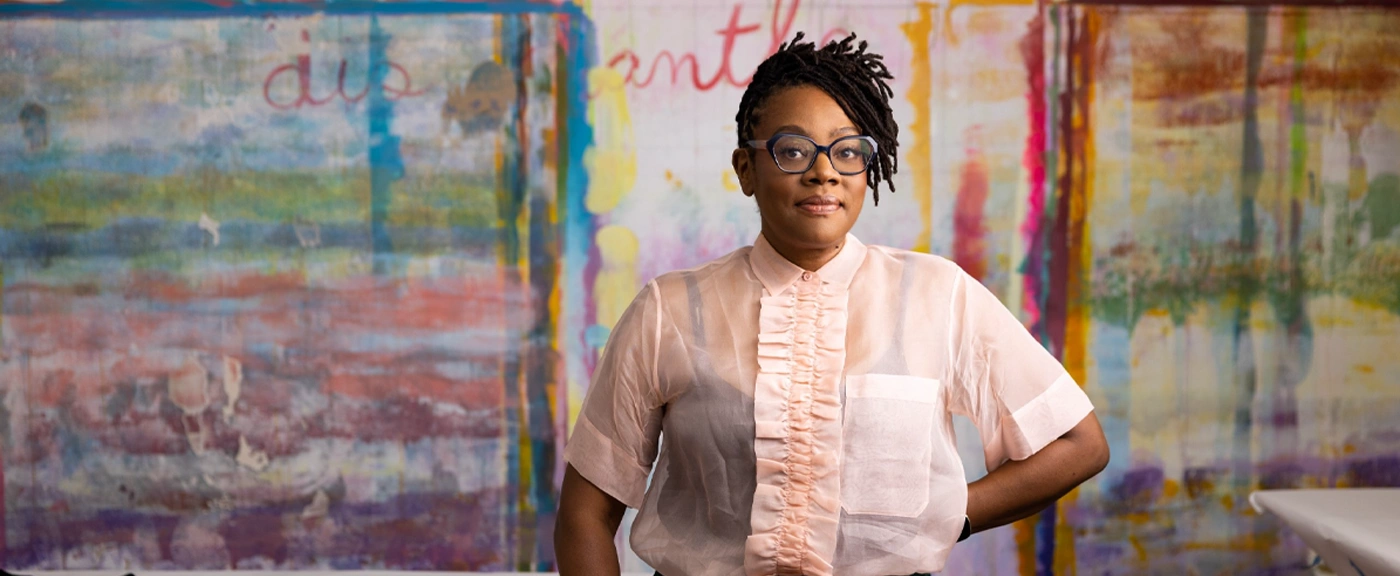
Cauleen Smith is a Los Angeles-based filmmaker and multimedia artist whose work moves across experimental film, sculpture, textile, and installation in pursuit of what she has called "the fragile, the forgotten, the flawed, and the fugitive." Since her debut feature Drylongso premiered at Sundance in 1998, Smith has built one of the most formally unpredictable practices in contemporary art, from hand-stitched protest banners at the 2017 Whitney Biennial to immersive installations drawing on the legacies of Sun Ra and Alice Coltrane. A professor at UCLA, recipient of the Ellsworth Kelly Award, and the Studio Museum's Joyce Alexander Wein Artist Prize, Smith is among the 111 artists invited to participate in the 61st Venice Biennale, In Minor Keys, the final curatorial project of the late Koyo Kouoh. We spoke with her about her contribution, her deep roots in Los Angeles, and what it means to carry Kouoh's vision forward.
Your practice has long lived at the intersection of experimental film, sculpture, textile, and sound, with a throughline of what you've called "the fragile, the forgotten, the flawed, and the fugitive." There's a real resonance between that ethic and the theme of this year’s Biennale: “In Minor Keys”, with its attention to enchantment, rest, and the small things that hold worlds. How are you thinking about your contribution sitting inside Koyo Kouoh's curatorial frame?
On a personal level I initially thought about what Koyo might be using in my work. You know we were born in the same year. Different continents but a pretty dynamic time for pop culture, so I felt like every time Koyo and I spoke we connected through that global energy of the underground culture somehow. And then as a filmmaker I put a lot of work into somewhat ephemeral things that only really live when viewed. You know a painting is being a painting even when no one is looking at it, but a film happens in the space between the screen and the viewer, it happens in time. So I wanted to share a time-based work that is about remembrance, about subterranean culture, and about language and embodied experience.
Your work has appeared in conversation with figures like Sun Ra, Alice Coltrane, Rebecca Cox Jackson, and Noah Purifoy, artists and thinkers who built worlds at the edges of the mainstream. Are there voices, living or otherwise, that have been particularly close to you in the studio as you've built toward this moment?
Like the British R&B band Heatwave said: “Always and Forever”. Ok but seriously, while being aware of the international dynamism of La Biennale, I’m just psychologically and spiritually deeply embedded in Los Angeles right now. LA poets, LA musicians, and LA neighborhoods are really captivating my attention. LA still feels like a city like no other, and like an insider secret for its inhabitants because no one else seems to get this place. When I made the work that centers LA poet Wanda Coleman’s body of work, and invited women composers and performers to interpret her poems, I too was trying to understand this place. What I think I ended up making was something of a portal. A way into not just my city, but a way to watch and look and be in any city. At least I think this is how the Wanda Coleman Songbook is working. Also, you know Wanda struggled through life. And had this way of describing her ferocious quests for love, dignity, pleasure, security that refused to shy away from pain, but just rips me open with moments of dazzling beauty. It’s so raw, and the way the world is right now. Maybe everyone feels a bit raw. So I am still thinking about how to make spaces that give us space, and tools, and experiences that allow us some perspective on this world.
From the hand-stitched banners at the 2017 Whitney Biennial to the Solar Flare Arkestral Marching Band moving through Chicago's South Side, your practice resists staying in one medium or one room. Is there a form you're working in for Venice that feels new for you, or that you've been wanting to push further?
Maybe the introduction of scent was a new thing. Collaborating with scent designer, Agustine Zegers was a wonderful experience, so much so that I am already conspiring on our next project together. Maybe I am never in the same kind of room, but I am obsessed with building rooms that invite experience without feeling coercive. Scent, like sound, enters the body physically and is viscerally experienced before it can be rationally processed. Having this as another element in installation has been fascinating. Understanding scent sensitivity and the ways it is both physiological and cultural is a bit of a preoccupation right now. I love the way perfumers describe smell, it’s all about place, light, temperature, - the words used to describe smells. My work is always so very specifically sited that I get really anxious when an installation has the (wonderful) opportunity to travel! Part of me wants to begin again and make a thing for the new space I am given. I’m learning how to make rooms that travel like spaceships. When you enter the room, you enter a new habitat....the discotheque, the parlor, the shed, the tree canopy, the volcano, the desert, the quarry, the vineyard, the swamp.... I have to learn new skills all the time just to learn how to talk to my collaborators.
But also relating to the work in Venice, which is not a new piece but one form 2024 that has only shown twice since then, I think just the role of the producer, the person who facilitates the needs of everyone else, but in this context make a record instead of a film - that was a really interesting experience. Difficult. I made some real mistakes that were absorbed brilliantly and gracefully by my collaborators. And it felt like a different kind of lesson in making about how to keep energetic flow feeling alive and feeling good. When I am alone editing or in my studio trying to make a drawing, my own feelings matter way less than my interest in producing something that arrests and destabilizes the known in a potential spectator. But as a producer, I offer the stability, the support, the pressure, the space, whatever is needed when it is needed. Maybe I should learn to do that for myself as well. It was a lesson.
You've spoken about Afrofuturism as a way of "speculating on the potentiality of what is known about technology and physics" to imagine other futures, but also about looking for what comes "after the trauma." What does that after look like to you right now, in 2026, and how is it showing up in the work?
Well, the aftermath of trauma is an ever-going thing with relapses, as well as remissions. I try to make work that is seeking pathways, space ways, orbits around thinking about how to apply what we know from studying the past to generate methods, plans and procedures for building futures. As we have always done. I have arrived at a rather dark conclusion regarding the United States as it exists today (and has existed since its conception in 1776). So the question is what now? Now that we see what this country wants for itself, what can we do in spite of that destructive hierarchical death drive? I am thinking about parasites, secret societies. I am thinking about crime and rebellion. I am thinking about hiding in plain sight, and camouflage. It’s wild to be living through the fall of an empire. When you read about it, the plot points and fulcrums are all so clear, so swift. Living it is another matter. That’s what I am thinking about.
Koyo Kouoh's passing last May was a profound loss for the field, and the fact that her vision is being carried forward by her team feels both heartbreaking and deeply consonant with the relational, collective spirit she modeled. What did her invitation, and her way of working, mean to you, and is there something of her presence you find yourself carrying into the studio?
Oh, what do I say about my encounters with the dazzling and marvelous Koyo Kouoh? In my last meeting with her, which was actually about my show, Afflict the Comfortable, Comfort The Afflicted, that is currently up at Zeitz MoCAA, we talked about our generation being the inheritors of an actively dialectic pan-Africanist ideology and practice. It wasn’t an abandoned dream for us, it wasn’t a failed theory, it was the thing that helped inform the decisions we made about our lives. And like so many aspects of Black culture, and African cultures, the practice is curious, porous, and expansive. Western ideologies have an obsession with purity and hierarchy. Obviously I can talk with more authority about Black American culture than I can for the entire continent of Africa, but I feel like I can say that curiosity and adaptation are methods of practice that one can see throughout African and African diasporic cultures. The ways in which European spectators expect Black and African cultural practices to teach them something, like literally anthropologically explain what it is like to be Black or to be Senegalese or to be Sudanese is really tedious and really wild to me because it means one must stand in front of art and then refuse to see it! One must instead stand before the art and demand didactics and then criticize the work for not really being art but for being too didactic! That’s a real thing in contemporary art criticism- to value work based on whether or not it makes the European spectator feel closer to, or better informed about, or more libidinally connected to the “black experience”— and it’s a terrible trap. I sense from Koyo’s statement that she has set up the artists she selected in such a way that we may escape that trap. And I am so excited to experience her vision. And so grateful. Grateful to have known her, laughed with her, debated with her, drank whiskey sours with her, and to have this privilege of being a part of her contribution to culture. Gratitude. That is what I try to carry into my studio every day.
The Biennale is, by design, a global conversation. Is there something specific you hope a viewer arriving in Venice from Lagos, or São Paulo, or Seoul takes away from your contribution? Something that visitors will travel back home with?
Oh I hope there can be an uncanny sense of intimacy with a cityscape and with our guide through it. I hope all who travel to La Biennale, travel even further in my installation and I hope that they let the poetry guide them.
Your studios in Chicago and Los Angeles have always felt like ecosystems unto themselves: research, reading lists, music, collaborators, students. What does a day in the studio look like for you in this stretch leading up to the opening?
Ah, I just moved studios, and for the second time in a year. So I am a little unsettled there which is why I think focusing on the local and being hyper specific seems to be what I am doing. Like literally dragging things like abandoned chairs off the street into my studio, and inviting people in my ecosystem, education, art, music, fashion, activism into my studio. And I am scheming, scheming about how to go back to the continent. Johannesburg is such a dynamic place, I was intrigued, I am hooked, I must find a way back. So maybe a lot of my head is in South Africa even while my body is in the studio in Palms.
For our members heading to Venice this spring, beyond your own work, is there an artist, a pavilion, or a corner of the city you're most looking forward to spending time with?
A really special thing happened for the In Minor Keys artists. We had the opportunity to join together to find ways of expressing solidarity with people in the world who are (and have been for decades) being subjected to great horrors and violences. We met on Zoom weekly. For me that meant getting in front of a screen at 6am sometimes to join the conversation, to contribute to projects as best I could. Of course I bring a lot of shame with me, being a citizen of a country that finances and profits from atrocity and initiates wars like a capricious toddler topples blocks. But I also tried to just listen and learn from my fellow artists, many of whom are absolutely impeccable organizers. I watched my peers listen, adapt, open up, extend, consider, invite, join, build, test the limits of our potential to form a group, a collective power (stuff artists routinely do in their practices, just not together!). For some artists it is really hard to join any group. Perhaps they have worked so hard to be recognized as singular geniuses that it must feel somehow compromising to join with others. But for me, the throng of the collective was such a beautiful sonorous pitch, a bristling cluster. It has been one of the greatest honors of my life to join with these artists in this way and I cannot wait to meet them all in person and read poems together, and hum together and dance together. I cannot wait.
Cauleen Smith's work is on view as part of the 61st International Art Exhibition, In Minor Keys, at La Biennale di Venezia from 9 May through 22 November, 2026. Her exhibition Afflict the Comfortable, Comfort the Afflicted is currently on view at Zeitz MoCAA in Cape Town. Smith is represented by Morán Morán (Los Angeles, Mexico City) and Corbett vs. Dempsey (Chicago).
Photo Credit: Joshua Franzos