Cultivist Conversations: Hurvin Anderson
24 Mar 2026
For nearly three decades, Hurvin Anderson has been making some of the most compelling paintings in Britain: barbershops, swimming pools, borrowed interiors, colours that arrive like a half-remembered afternoon. We sat down with him ahead of his first major solo show at Tate Britain, on view 26 March through 23 August 2026, to talk about belonging, memory, and the films that taught him how to see.
This is your first major solo show, and it spans your entire career, from your student work to new, never-before-seen paintings. What does it feel like to see your practice laid out like that? Is there anything that surprised you when it all came together in one room?
When Dominique (Heyse-Moore) and I began planning the show together we were always keen to sort of replicate the rhythm of the way I have always worked within the layout. So nothing is chronological but instead, circles back and forth between time and theme. As a result, there are some very early student pieces alongside later works and that has been really interesting to see. It has restarted some conversations and there are lots of preoccupations that have clearly been with me for years. You can see the continuity of that and it’s also made me think a lot about when paintings are finished and if they ever are.
So much of your work moves between the UK and the Caribbean. Going between memory and place, belonging and distance. Growing up as the youngest of eight, and the first born in Birmingham, how much of that position in your family shaped the way you see those two worlds?
I mean, the experience of this is of course a lot of what the work stems from but rather than speaking solely about my personal experience, I suppose I’m trying to look more widely at the shared experience of a community, or communities, what it really means to belong to a place, where those overlaps of experience happen, what is inherently part of you, regardless of where you physically are, what you carry with you through time, place and in memory too. But also, not just looking back, looking forward to how these experiences are carried on through generations. I think I’ve always felt like the watcher, observing from the sidelines and maybe that has been something intrinsic in the work.
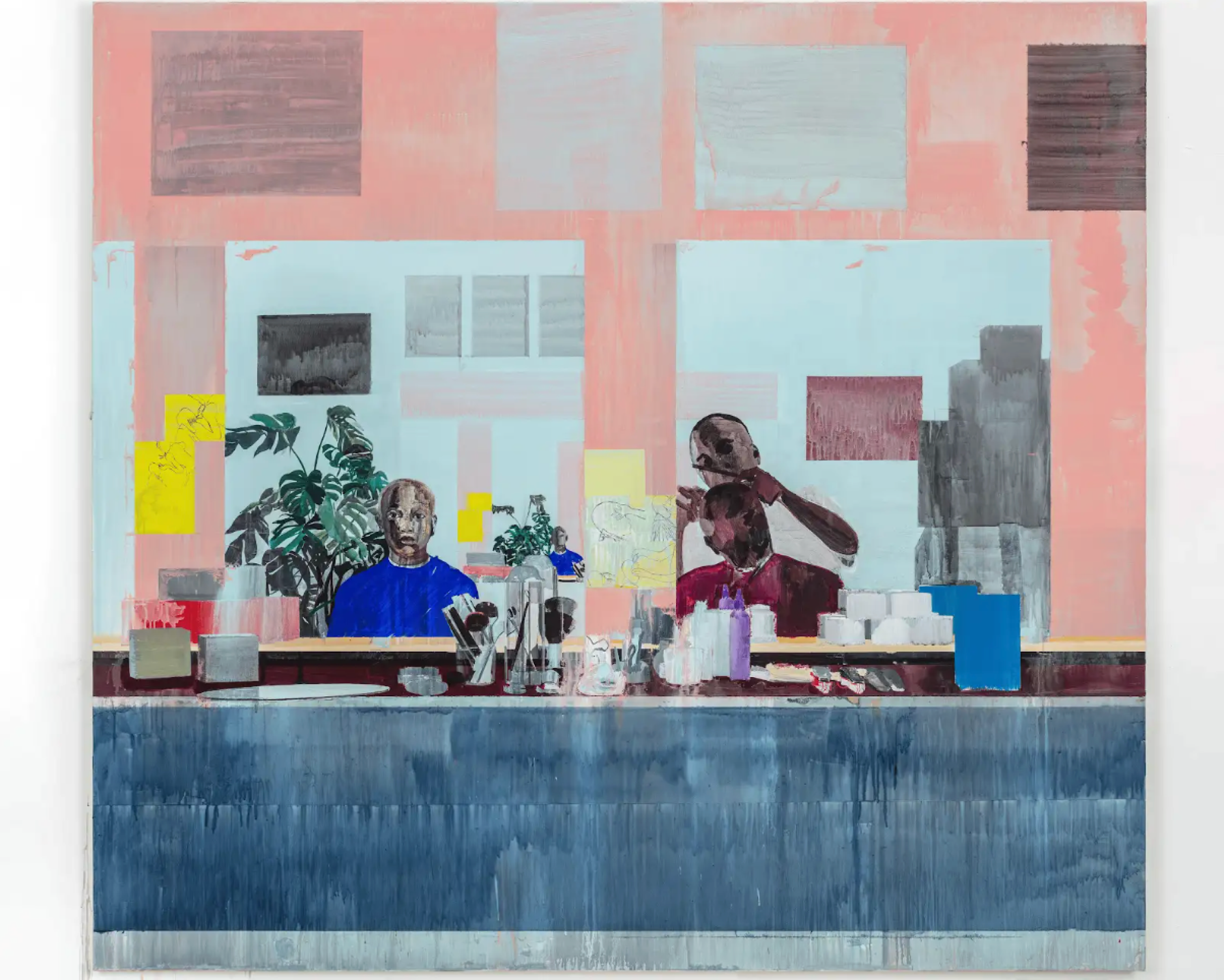
Photo Credits: Hurvin Anderson “Shear Cut” (2023) Courtesy of the Artist
You've described the barbershop as a point of connection to Caribbean culture. A place that holds memory, identity, community, but you've also spent nearly two decades deconstructing and reassembling the same one. Is there a version of that room you're still chasing? Or has the painting itself become the place?
For me, the barbershop was always a fascinating subject matter, a place central to community and is often a real meeting place, a hub. It also can be a heavy subject, weighted with a lot of political history as well as a place of lightness and expression. A place of our own. On top of that, I was thinking of the bare bones of composition, how little you need in the canvas in order to still retain the essence of the space. The scene-setting of the bar in Manet’s Foiles-Bergère and the abstraction of Mondrian were also on my mind. And how many different versions of the space can exist and still retain the central feeling of breaking it down to the simplest blocks of colour and really getting to what it is to be within that space. It’s become about technical observation and also quite allegorical in the later works. That series feels complete for me now.
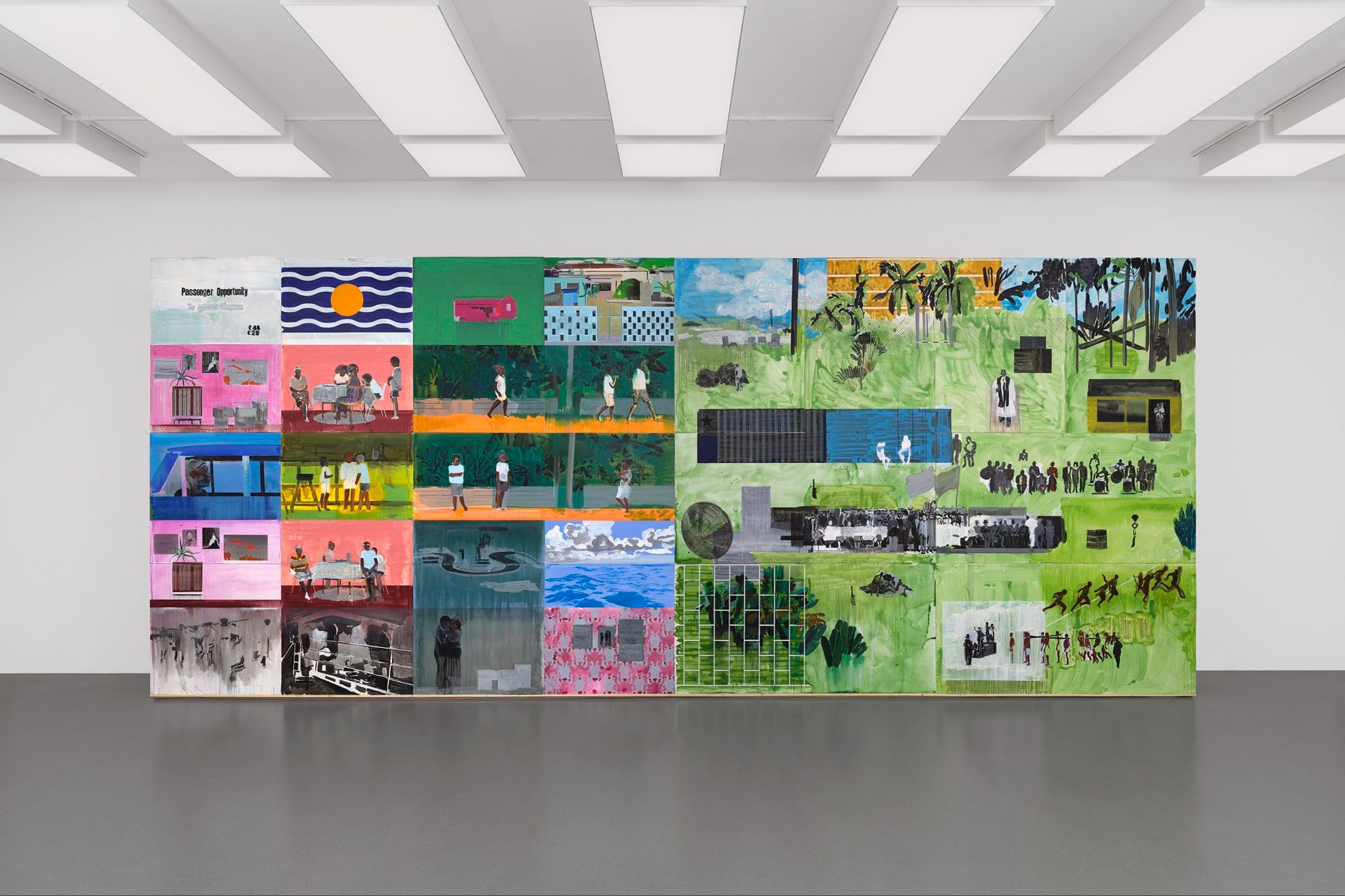
Photo Credits: Hurvin Anderson “Passenger Opportunity” (2024) Courtesy of Pérez Art Museum Miami
Your use of colour is atmospheric and alive, there's something almost cinematic about it. Are there films, photographers, or other visual references that have shaped the way you think about light and composition?
So many. I’ve always drawn inspiration from a variety of sources, particularly photography and film. I’m particularly interested in film in terms of atmosphere and scene composition. I like Kurasawa. There are great time-shifting perspectives in Rashomon where he looks at a scene from 3 different positions. Classic films like Perry Henzell’s The Harder They Come and his sequel No Place Like Home. Also Horace Ove’s Playing away and Pressure were big influences. There’s a large scale work in the show called Passenger Opportunity (above) which I created for an exhibition at the Perez Museum, Miami, it is deliberately very filmic. The composition is almost like storyboards, telling a story piece by piece in a way that I haven’t really looked at before. Recently I’ve looked at early works by Jamaican photographers in the 19th century, particularly Adolphe Duperly.
Memory seems to be a kind of unreliable collaborator in your work, you layer places on top of each other, sometimes revisiting the same scenes across years. Do you think of painting as a way of getting closer to or further from a memory? How does inviting people to view these paintings expand the depth of those memories?
Memory is rarely reliable but often those half rememberings say so much more than a simple recreation of the actual event or experience ever could. I like the inbetweenness of that and for me it is often that tantalising moment when you are reaching for something that I am trying to express in the work. I think it keeps it the right side of nostalgia, it’s evocative but you still can’t place it. It’s kind of like reaching for a word and you almost get there but you never quite do. Memories, dreams, thought processes are always circuitous and ideas can co-exist on the same canvas.