Cultivist Conversation with Sophie Neuendorf
29 Sep 2026
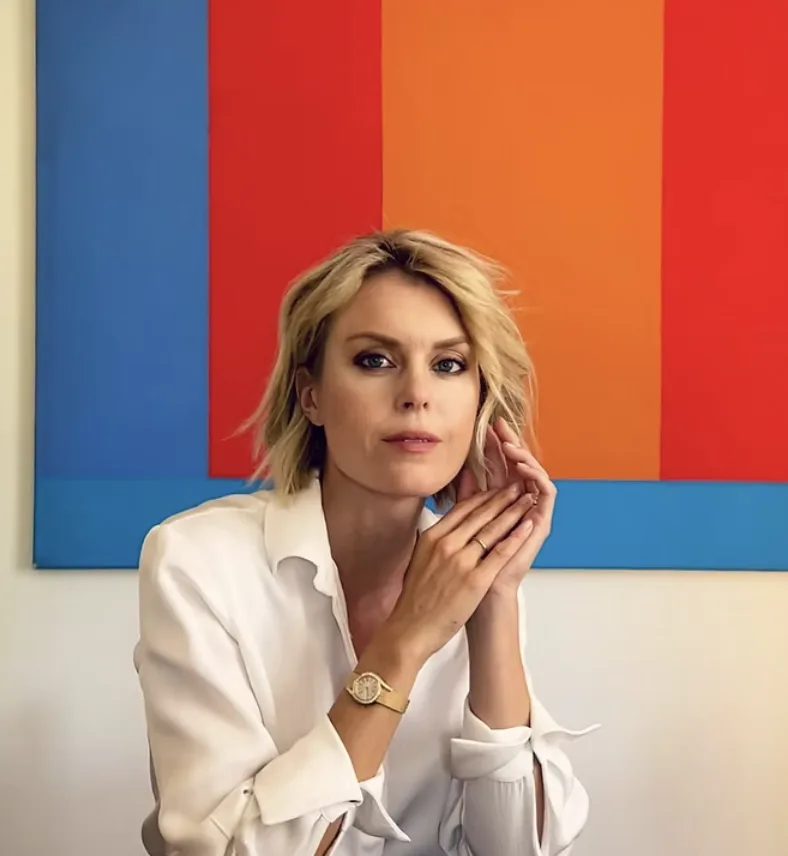
In September 2026, Cultivist Members from around the world embarked on an Art Trip to Madrid. Part of this itinerary was a a visit to the home of Sophie Nuendorf Teba, Vice President at Artnet, and her husband Jaime Patiño, Count of Teba. Along the walls of their home, Old Masters from Jaime's family collection hang alongside Modern and Contemporary works from Sophie's collection, a preview of a conversation that turned out to be about exactly that kind of bridging.
As VP at Artnet, the company founded by her father, Neuendorf has spent over a decade helping collectors and institutions make sense of the market's data. She's also Chairman of the Supervisory Board at Galerie Neuendorf, teaches at both IE University and Bocconi, and with her brothers Henri and Albert, runs an artist residency out of her family's home in Mallorca. We asked her to walk us through how all of that fits together, and where she still finds herself drawing the line between what the numbers can tell her and what only a room full of art can.
You joined Artnet in 2012 helping build out its early social media presence, back when only a handful of galleries even had a Facebook page. Now, as Vice President, you're the one explaining the market to shareholders and institutions. What's the biggest shift you"ve seen in how collectors actually use data to make decisions, versus how they used to?
I’d say the biggest shift is that data has moved from being confirmatory to genuinely decision-making. As my father founded Artnet, I’ve been around the art world and artnet my whole life. But when I officially joined in 2012, data was still relatively niche in the art market. Collectors would look at auction results or price histories mainly to validate decisions already shaped by taste, relationships or instinct.
Today, the data itself has become much richer—and, importantly, much more analytical. Collectors can look beyond headline prices to understand price trajectories, liquidity, sell- through rates, auction frequency, comparables and the performance of specific periods or bodies of work. When you combine that quantitative layer with qualitative signals—museum exhibitions, gallery representation, institutional recognition and critical attention—you get a much more nuanced picture of an artist and a particular work.
What I find most interesting is that data hasn’t replaced intuition; it has made it more informed. It allows collectors to test assumptions, identify patterns and ask better questions: Is this price justified? How does this work compare? Is there genuine demand behind the market? Where might there be an opportunity? For me, that’s the real evolution: the advantage is no longer simply having access to information - but being able to interpret multiple data points in context and turn them into insight.
Beyond Artnet, you're also Chairman of the Supervisory Board at Galerie Neuendorf. What's different about that vantage point, actually helping steer a gallery, compared to the decade-plus you've spent on the data and partnerships side of the business?
To be honest, it gives me a very different vantage point. At Artnet, I’ve spent years looking at the market through data, online transactions, partnerships, and a broad international lens. Through Galerie Neuendorf AG, I’m much closer to the long-term strategic and financial considerations behind collecting and managing assets. It gives me a more holistic perspective on how value is created and preserved over time. The two perspectives complement each other: Artnet gives me a broad view of market dynamics, while Galerie Neuendorf gives me a more direct understanding of ownership, stewardship, risk, and long-term value creation in the art market.
You've described feeling like you were born into the art world, mingling with people like Leo Castelli as a child and growing up surrounded by works by Warhol and Baselitz. When it came time for university, you deliberately chose International Business Administration over art history because you didn't want to be a cliché. Did that decision cost you anything at the time, and if so, do you see it differently now that the “business side” is where you've built your career?
No, I don’t feel that decision cost me anything—I’m certain it was the right decision. I grew up surrounded by art, so studying art history would have been the obvious choice, but I deliberately wanted to understand the business side of the world I was entering. International Business Administration gave me a different perspective and, ultimately, a much broader toolkit.
Looking back, that combination has been incredibly valuable. I’ve always had a deep personal connection to art - but understanding markets, finance, strategy, and governance has allowed me to approach the art world from a different angle. I never felt I had to choose between art and business; my career has really been about bringing the two together.
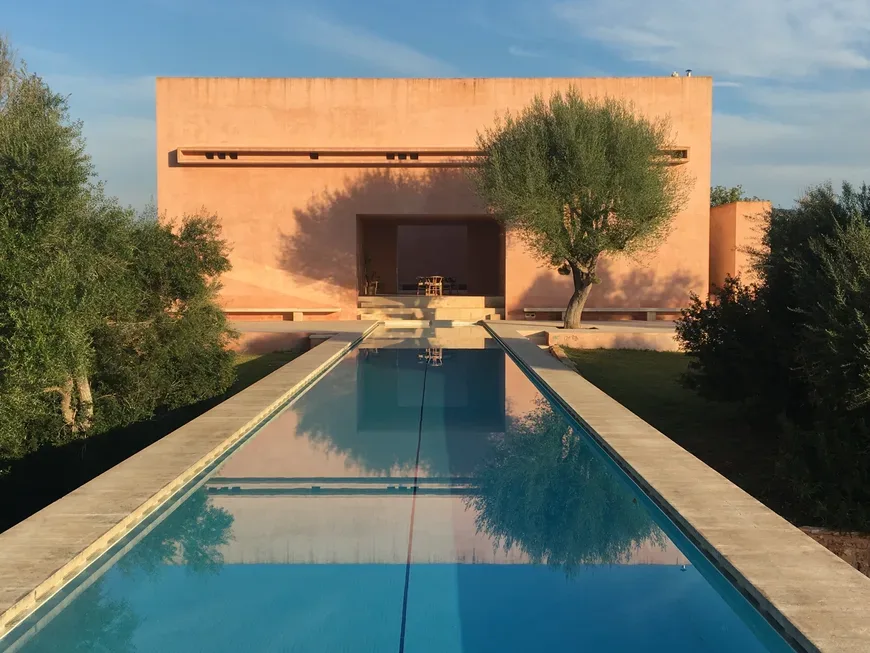
Pool at the Neuendorf House in Mallorca. Photo by Ulrike Schamoni
The Neuendorf House in Mallorca, the Pawson and Silvestrin building your parents commissioned in the 80s, is now also home to an artist residency you conceived with your brothers Henri and Albert. What made you want to open up something so personal, your family home, to artists who have no connection there?
The house has always been much more than a family home—it is a place deeply connected to art, architecture, creativity, and the way my parents lived. Opening it to artists feels like a natural continuation of our father’s tradition of supporting artists and creating an environment where creativity could flourish. My brothers Henri and Albert and I wanted to carry that spirit forward in our own way, giving artists time, space, and freedom to think and work in a very personal setting.
For me, it is also a meaningful counterpoint to my work at Artnet, which is naturally very data-driven and focused on the business and infrastructure of the art market. The residency brings me back to the other side of the equation—the human, creative, and ‘zeitgeist’ side of art. It is less about measuring value and more about creating the conditions for new ideas to emerge. That contrast is important to me, and it makes the residency feel like a very natural extension of our family’s relationship with art.
You also sit on the selection committee for the Belmond residency at La Residencia in Deià, where this year you helped choose three artists out of more than 600 applicants. What separates the work that stays with you from everything else in that pile?
What stays with me is work that has a strong sense of authenticity and a clear artistic voice—something that feels like it represents the zeitgeist. With more than 600 applications, technique alone was not enough. I’m drawn to work that surprises me, that has an unexpected perspective, or that continues to occupy my mind after I’ve moved on to the next application.
I also look for artists who are still developing their language and could genuinely benefit from the time and environment a residency provides.
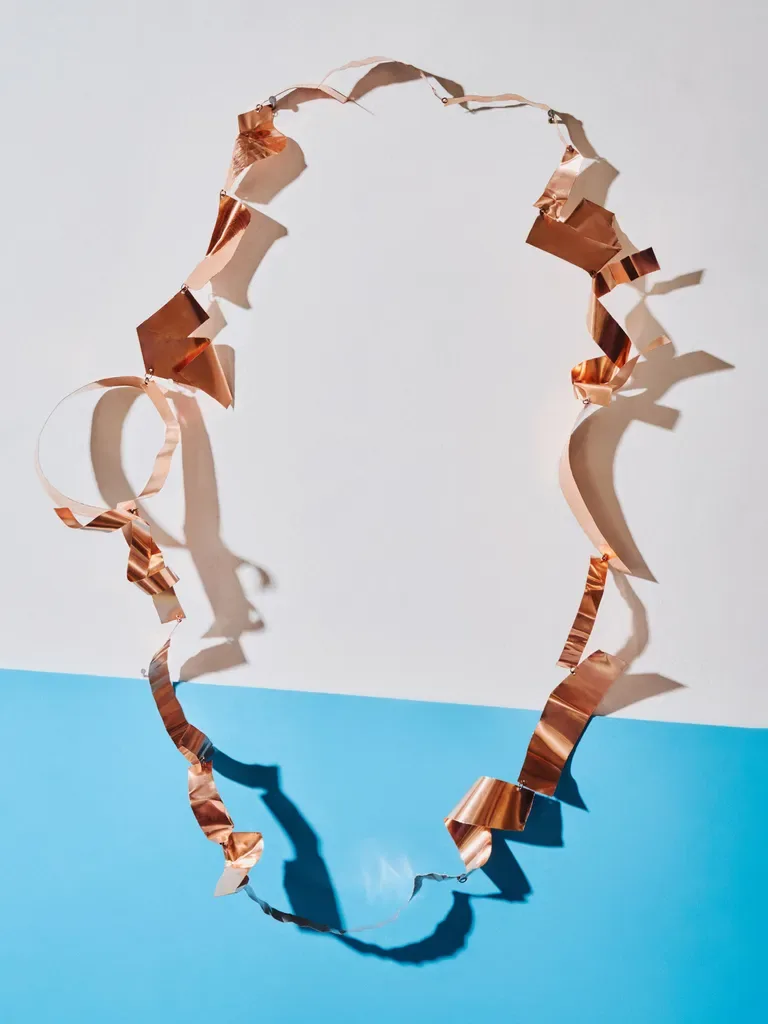
One of Kaori Juzu's works in metals, created while at La Residencia, A Belmond Hotel during her Artist Residency. Photo by Claudia Maurino
You and your husband Jaime were living in different cities before a chance meeting elsewhere brought you together. How much did that factor into you eventually landing in Madrid, and has the city changed how you experience the art world compared to New York or London?
Madrid was very much a personal decision, but it has also had a significant impact on how I experience the art world. My husband’s family have a wonderful collection – and I’ve brought over some of my family’s collection, juxtaposing Old Masters with Modern/Contemporary works. Madrid has a very strong and increasingly international art scene, but it still feels more personal and relationship-driven than New York or London.
There is a real sense of community between collectors, galleries, museums, and artists, and I value that enormously. At the same time, living in Madrid while working internationally gives me the best of both worlds: I can remain closely connected to the global market without feeling that I have to live inside its constant rhythm.
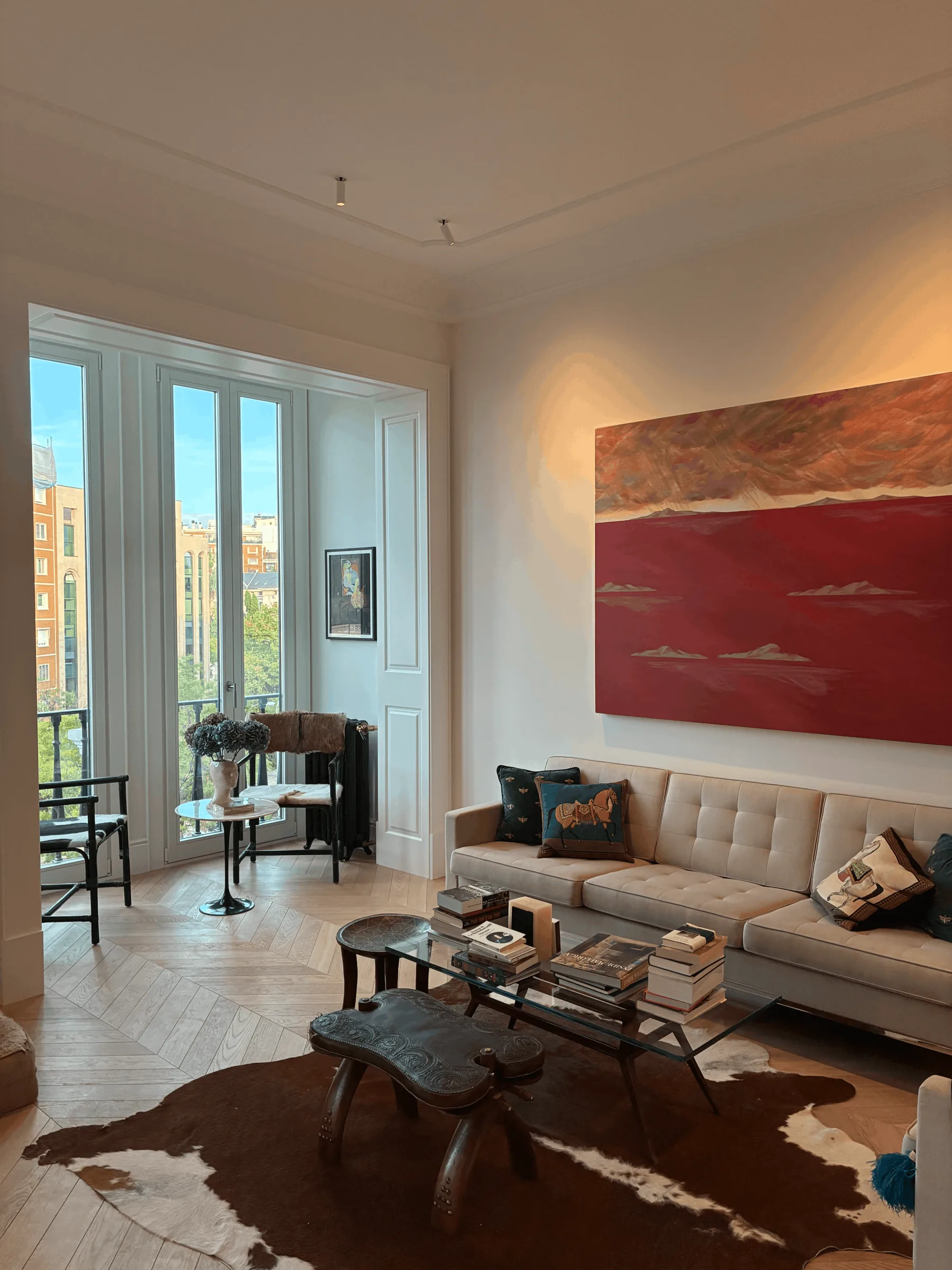
Photo of Sophie Neuendorf's Madrid home, taken on a collection visit from our recent Madrid Art Trip
You've talked about AI helping make sense of auction results and market trends, while still insisting no algorithm can replace the feeling that starts a real collection. Where do you personally draw that line, between what the numbers can tell a collector and what they can't?
For me, data and AI are incredibly powerful tools for understanding the market, but they can’t tell you why a particular work moves you. They can help a collector understand pricing, an artist’s trajectory, comparables, auction performance, and where there may be opportunities or risks. But the decision to live with a work, to build a relationship with an artist, or to make that first purchase is ultimately emotional and deeply personal.
That’s where I draw the line. The numbers can give you context and confidence, but they can’t replace curiosity, taste, intuition, or the experience of standing in front of a work and feeling something. In fact, I think the more data-driven the market becomes, the more important that human response is. AI can help you navigate the market; it can’t tell you what you what your emotional response or experience should be.
Between teaching at IE University in Madrid, guest lecturing at Bocconi in Milan, and now living in Madrid yourself, you're constantly moving between the classroom and the market. What's something you find yourself telling students that you wish someone had told you at their age?
I often tell students not to try to define their career too early. The most valuable opportunities in my own career came from combining things that, at the time, didn’t necessarily seem connected—art, business, technology, data, and relationships. I would encourage them to stay curious, develop a strong foundation, and be open to unexpected opportunities rather than following a predetermined path.
And perhaps most importantly, don’t be afraid to take a path that is different from what people expect of you. That has certainly been true in my own career.
Talking with Sophie Neuendorf, the throughline isn't really a single choice (business over art history, data over instinct, Madrid over London), it's a refusal to see those as choices at all. That came through clearly in person too, in an apartment where two family collections sit side by side rather than competing for space. Our thanks to Sophie and Jaime for having us, and for a conversation that made the case, once again, that the most interesting people in this industry are usually standing on more than one side of it.