Cultivist Conversation with Kate Pincus-Whitney and Merrick Adams
24 Feb 2026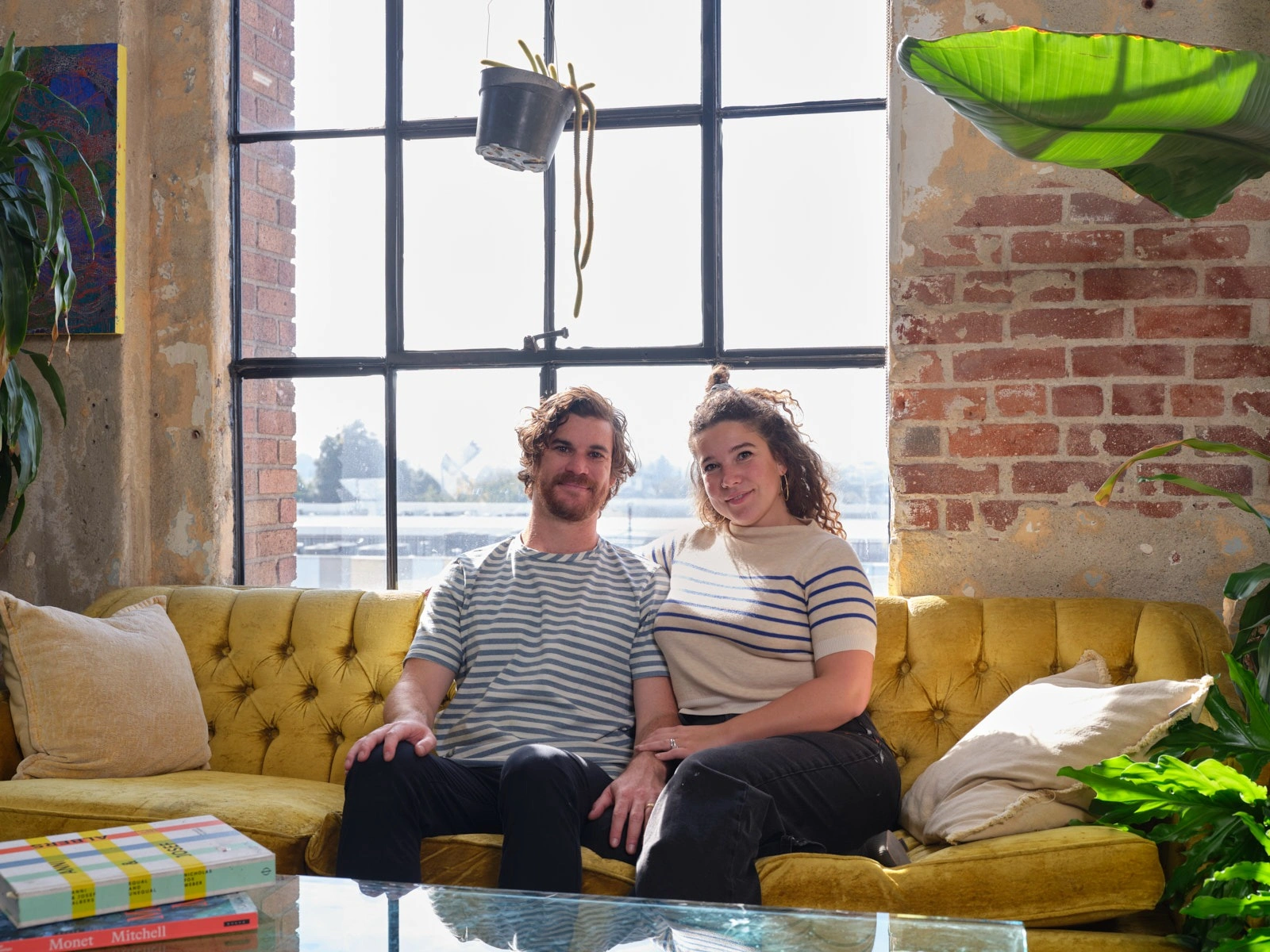
In their shared Los Angeles studio, artists Kate Pincus-Whitney and Merrick Adams build symbolic worlds shaped by storytelling, material culture, and contemporary ritual. Both MFA graduates of the Rhode Island School of Design, they work across painting, printmaking, and sculpture to explore how myth, memory, and perception shape the way we see and inhabit the world. Pincus-Whitney’s maximalist tablescapes turn food and domestic objects into narrative devices, while Adams’ layered compositions examine pattern, natural systems, and the tension between visibility and concealment.
Join us in conversation with Kate Pincus-Whitney and Merrick Adams as we explore their shared studio practice and the inspirations shaping their richly symbolic work.
Thank you both for joining me! I understand that you got your MFAs from the Rhode Island School of Design. Are there any influences from Rhode Island that you miss having now that you’re in Los Angeles?
Thank you so much for having us, we are so excited to be talking with you today.
M: I think the biggest things I miss from RISD are the community and access to the multiplicity of facilities. I was trained in traditional printmaking techniques and the ease and proximity of accessing world class print facilities made for a lot of exploration in my studio. From metal shops, to textiles, to ceramics, there really was every opportunity to explore how these mediums interact and play off each other. There was such a freedom and privilege to have time to play in the studio and get immediate feedback from your community of peers and professors.
K: I totally agree, I think having the access to facilities and the incredible minds who know how to use them is really what I miss most.
I've heard that there's always music playing in your studio, but that there is a large wall that divides the space right down the middle. Do you have a shared playlist of studio music? Or is it more "whoever gets to the speaker first?" Any songs or artists in your regular rotations?
K: Haha, thank goodness for the wall! The act of listening is important to both our works in different ways. We really have two different worlds existing in this one shared space. I am very lucky that Merrick enjoys wearing noise canceling handphones, because I need to have music blasting. Rotating different genres really helps me tap into other states of conciseness while painting. My music taste varies greatly but I do find each painting has its own sounds track which effects everything from color, to objects, to feel etc. Lately I’ve been listening to a lot of Ethiopian Jazz, Motown, Billie Holiday, Crosby Still and Nash, Bob Dylan, Joni Mitchell, the Cure, Stephen Sondheim, Jamilla Woods, and Little Dragon. Thinking about music and its relationship to consciousness and harmony- Id highly recommend diving into Pythagoras’ ‘Harmony of Spheres”. You can draw direct connections between the different languages spoken by the arts.
M: I am usually tucked away on my side, headphones on. I listen to a lot of books of tape and podcasts during the day. When I am working at night, I listen to a lot of 90s hip-hop. Gang Starr, KRS-ONE, Digable Planets, The Pharcyde. That’s all the stuff my older cousin listened too when I was growing up, so I got a lot of hand me down CD’s.
You two have very different styles when it comes to your art, but clearly you work well in the same space. Is there anything in your studio that acts as a shared inspiration?
M: You know, this is a question we get a lot. Our studios are attached but feel like two different worlds. I think at the end of the day though our reasons for making are very similar, we just have two different languages and approaches of how to get to a similar endpoint. Both of our work centers around consciousness and spirituality/mysticism. We have a deep shared belief in arts ability to altar how one sees the world around them. Whether in Kate’s work, where objects transmute and become relics; tell the story of who we are by what we surround ourselves with, or in my work, where light and water become a moment for self-reflection and the profundity of nature reminds oneself that we are just a small part of the endless cosmic ocean. Both works ask you think about how you interact with the world around you.
Kate, your work regularly features books, floral plants, open flames, and most prominently, food. Do you have a favourite type of detail you get to add into your art?
K: Like a gestalt, details are vital to the ‘becoming’ of the whole painting. I think of each object as an actor in a play, the table is the stage in which all the dramas of the heart the head and the stomach are played out. Each work is filled with “loaded objects”, where triangulations of symbolic, personal, and historical meanings are used like different words, making up a sentence. The storytelling takes place between the objects and their relationship to each other. As a very dyslexic person, my natural language has always been visual, so a lot of the details within in the paintings are a reclaiming of the written language. I think a lot about archetypes and Jungian Sand-trays, where the viewer gets to activate their own narrative through objects they identify with. I think one of my favorite details to work on are the ‘candles’/ spaces of illimitation. The symbolism of flame is deeply intrinsic to lighting the path for the unconscious. As I work, the painting often takes on its own gravitational pull, where at the heart are the candles, pulsating with energy. It is important to know none of the works are based from real still lives, or scenes that have ever existed, rather each object is chosen and then painted as if creating its own myth in every piece.
Merrick, you’ve recently gotten yourself back into sculpting after an artist residency with La Serra Collective. Is there something about your style of reductive painting that naturally draws you to clay and ceramics? Or does that interest come from elsewhere?
M: Coming from a printmaking background, ceramics felt like a very natural step. I am very interested in process and how a process dictates an outcome. Much like printmaking, and reductive painting, there is an outcome I am looking for, and working backwards from that point through different stages and parameters is just kind of how my mind works. Ceramics is a total embodiment of that way of working. Sculpture also just allows you as the artist to let people fully into your world, there is something about the physicality of an object that is more honest. It is like watching a TV show verse seeing a play. There is no fact, there is only process. Something happens in process, whether it’s a deckled edge of paper, a leftover misprint, or just a scrap of clay that is added, something happens that shows in its material form a process of thinking that is tangible, and I like that. William Kentridge once said “that the paradox, the contradiction, the ideas that are sitting in the margin are not just there as mistakes, as aberration in our understanding of the world, but are in fact central to it. Believing in the mistranslation.” Working in a new material like clay, allows for a lot of those mistranslations.
What’re you working on now? Anything our readers should be on the lookout for in the next couple months?
M: I am currently working on my second solo show with Turn Gallery in New York that will be opening at the beginning of May. As well as my first Los Angeles solo show with La Loma Gallery that will be opening in the fall.
K: I am just starting a new body of work called, “Persephone’s Garden”. I will have my next solo show at Fredericks and Freiser New York Early 2027. I am working with a lot of new materials, and I am so excited to share soon. I have some exciting surprises I really can’t wait to reveal.
As you’re both established artists, are there any new or emerging artists you’ve been keeping your eyes on recently?
M: There are so many incredible painters right now, and I don’t know if they are considered ‘emerging’ but a few artists I think are on to something exciting are Ryan Dobrowski, Max Xeno Karning , An Hoang, and Daniel Um. I also think Carlo Vitale is an incredible artist who more people need to be looking at!
K: Some people I’ve been loving recently are Olivia Jia, Phoebe Helander, Katlyn Ledford, Jarret Key, and Sholto Blissett.