Cultivist Conversation: Massimiliano Giano
31 Mar 2026
The New Museum just doubled in size. On 21 March, the museum reopened with a 60,000-square-foot expansion designed by OMA’s Shohei Shigematsu and Rem Koolhaas, and a monumental inaugural exhibition to fill it. New Humans: Memories of the Future brings together over 200 artists, scientists, filmmakers, and writers to trace how humanity has imagined itself in the face of technological transformation, drawing a striking parallel between the 1920s and the 2020s.
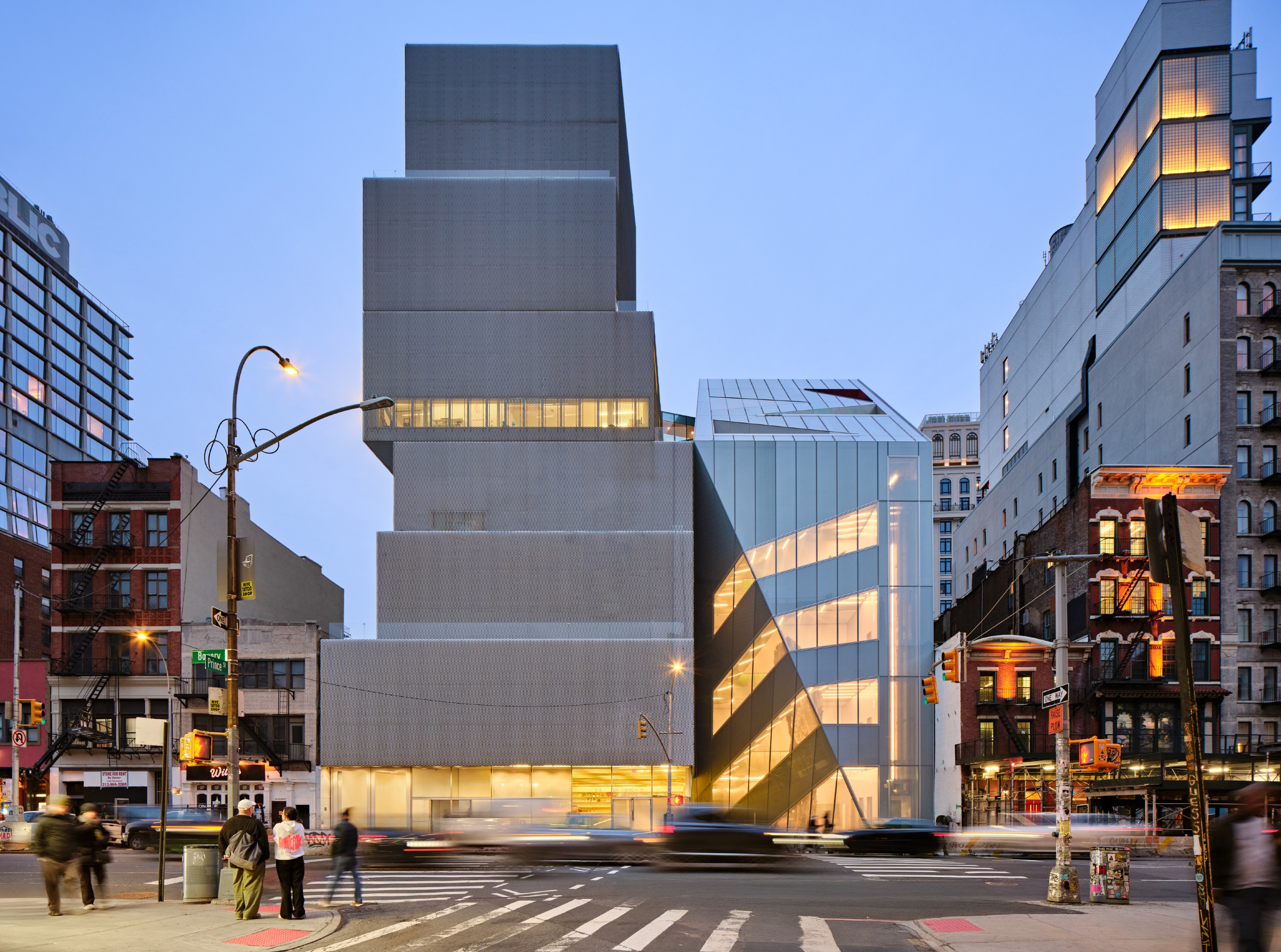
The New Museum, view from Prince Street, photo by Jason Keen
We spoke with Massimiliano Gioni, the museum’s Edlis Neeson Artistic Director, about the curatorial vision behind the show, what the new building makes possible, and why a museum without a collection might be the best place to ask what comes next.
The opening exhibition New Humans: Memories of the Future brings together more than 150 artists, scientists, filmmakers, and writers under one roof. That’s no small undertaking. What was the curatorial vision behind it, and why is this the right moment for that conversation?
New Humans is an exhibition I have been thinking about and quietly working on for many years. There are works in it that I have seen more than 20 years ago and contributions I have been trying to include in an exhibition for decades. The show itself came together in a couple of years but its gestation was very long and I was researching it for decades, setting aside works in my mind and in long lists in my computer.
When I started thinking about the inaugural show for the new New Museum, a few years ago, I thought that New Humans was the perfect place where to start. First of all, there was the very special occasion of the inauguration of a new building. Opening a new building in 2026 is a very different proposition than inaugurating a new museum in 2007, which is when we opened our SANAA building. In the wake of Covid and in the middle of multiple global crises of apocalyptic proportions, ideas around expansion and growth have become more complicated, perhaps healthily so. The very idea of whether there is such a thing as the future is certainly not a shared reality anymore. I thought that opening a new building was a vote of confidence in the future, and, as such, an exhibition that surveyed different ideas of the future and the ways in which artists, thinkers, writers, architects, and visionaries had imagined the future, was the right place to start. So that was one of the initial inspirations, which had more to do with the history of the museum itself and the peculiar occasion of the inauguration of a new building.
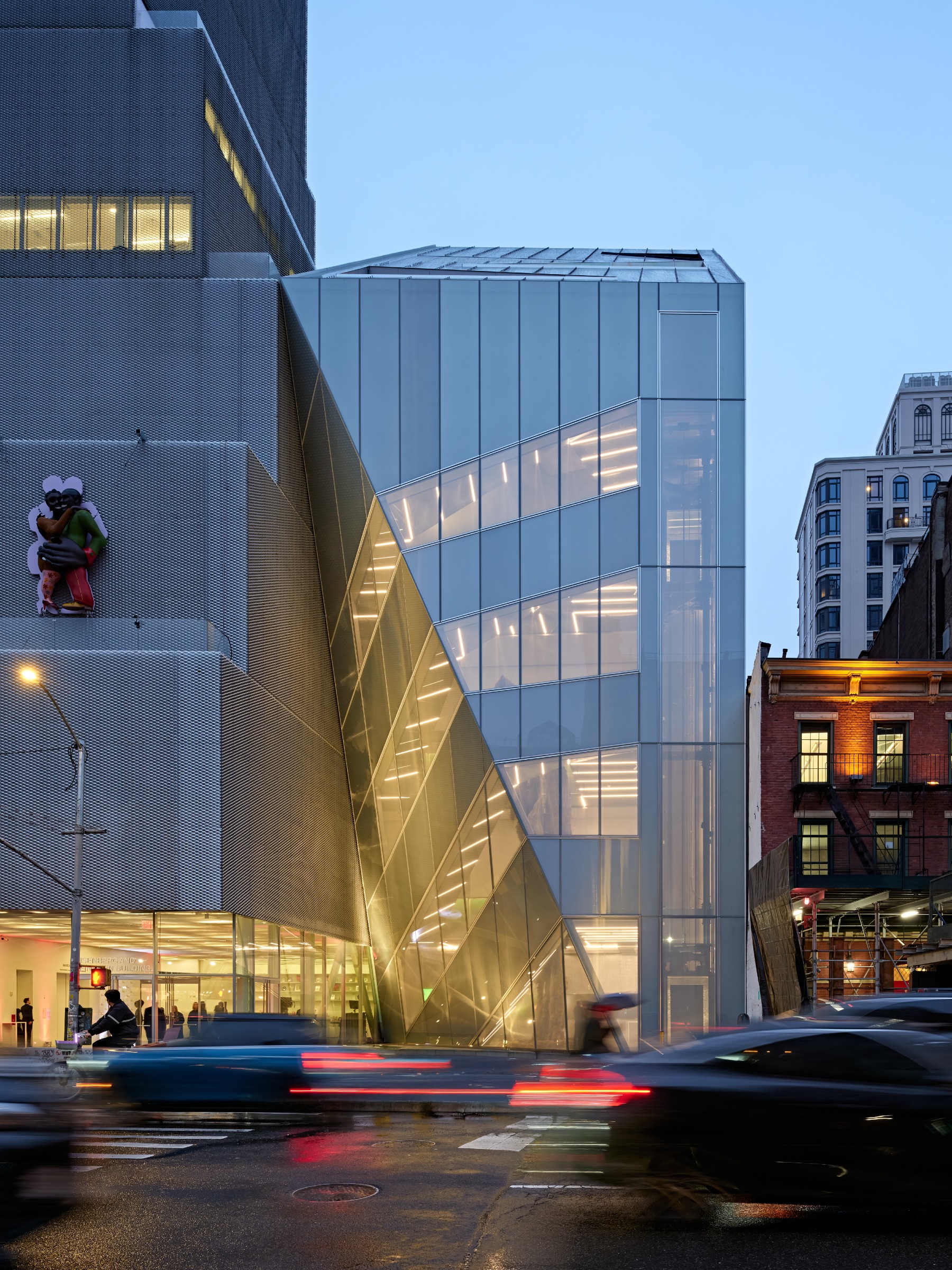
The New Museum’s Building expansion, designed by OMA
And then there was the historical moment in which we find ourselves in: today we are confronted with new technological advancements which are so radical as to pose new existential doubts to all of us as humans. I often use the experience, which we all have multiple times a day, of a computer asking us to prove we are not robots, by clicking on a box or recognizing images. When it is a machine asking you to prove you are not a robot, it means we have reached new heights in the definition of what a human is. It is precisely in these moments when technological innovation appears almost magical, that we retreat into the domain of the mythical and so I thought it would have been interesting to look at the work of artists as the greatest myth makers… and myth busters... On many levels New Humans is less an exhibition about technology, and more an exhibition about the stories we create to explain our relationships with technologies and to articulate our fears and hopes around them.
I thought that this exploration of the shifting definitions of the human under the pressure of new technologies could become richer and more rewarding if we looked at the present and the past simultaneously, through a bifocal length, so to speak. New Humans is a show built on a symmetry between the 1920s and the 2020s: the word robot was invented in 1920 and many of the fears and hopes we project today onto new technologies echo the same fears and hopes that agitated humanity at the dawn of the machine age. In this sense, New Humans is a show split between archeology and prophecy: in this symmetry the exhibition raises a warning, as it demonstrates the fateful connections that linked totalitarian regimes to technology back in the 1920s, while suggesting a new possibility for hope: if we have survived the most tragic consequences of technological innovation one hundred years ago, we will be able to survive them again.
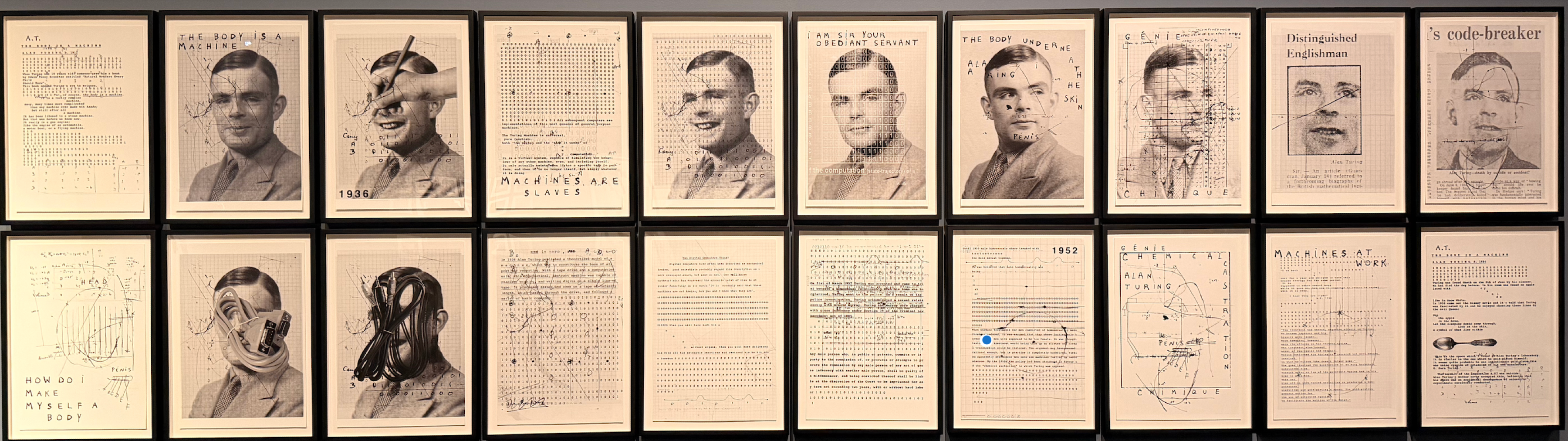
Henrik Olesen “A.T.” (2012) Narration of the life of Alan Turing, known as the father of theoretical computer science, through digitally collaged texts
New Humans is unusual, and I hope quite original, in the way it combines contemporary art and historical materials, popular culture and absolute masterpieces. In the exhibition you will encounter paintings by Salvador Dali and impressive loans from some of the most important museums in the world, displayed next to comics, architectural models, and actual robots like the prototype of ET and Alien (below) or the floating drones by Anicka Yi which actually fly over the exhibition. It’s a show full of moving parts: a machine itself that tickets like a clock counting down to the future.
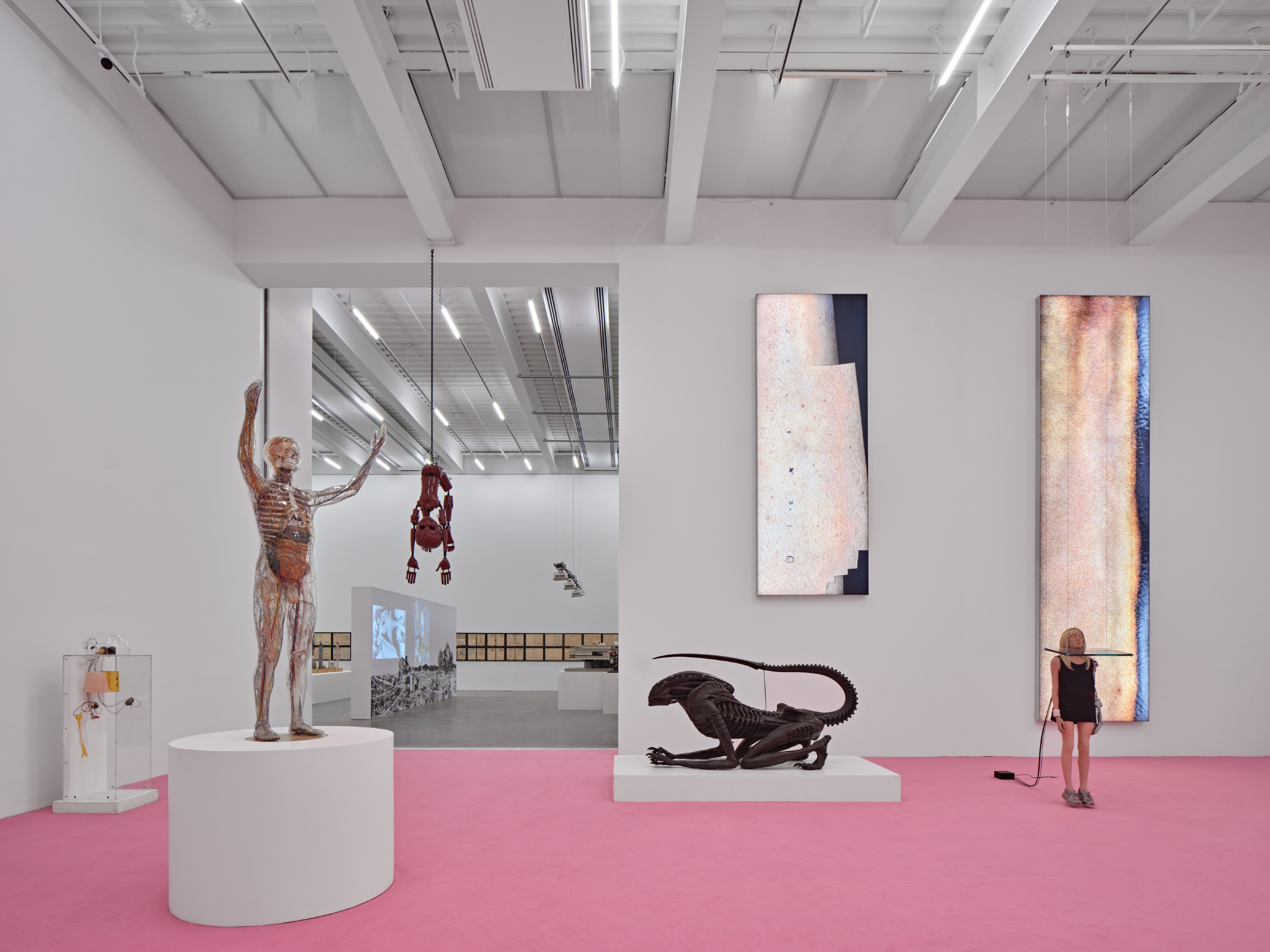
Hall of Robots, gallery view
The new building is designed by OMA, spearheaded by Shohei Shigematsu and Rem Koolhaas, and sits right alongside the original building designed by SANAA. How does the architecture itself shape the way visitors will experience art differently in this expanded space?
The building itself certainly served as an inspiration for the exhibition, not only because, as I mentioned above, opening a new building is an interrogation about the future, but also because OMA as a firm, from its very name “Office for Metropolitan Architecture”, has interrogated the ways in which we imagine cities and modernity. Rem Koolhaas himself started his career as a writer with “Delirious New York”, which is a wonderful book that looks at the myth of the “metropolis of the future”, as Hugh Ferris called it. The architecture of the new building itself, with its facade that resembles an arrow pointing to the future and its industrial utilitarian materials, is charged with intimations of the future and full of references to the history of modernism. Shohei Shigematsu is an architect who can process both the tradition of Rem Koolhaas’s OMA and, more broadly, the tradition of modernism, and mix it with a distinctive contemporary feeling. The staircase and the atrium have a weird digital quality about them, their geometry having the complexity of a strange architectural landscape in a videogame.
All these elements served as an inspiration for the exhibition itself and I hope that the viewer, when strolling into the galleries, particularly the ones featuring architectural elements, will have the peculiar experience of finding themselves confronted with miniature cities (below) and architectures while also feeling like being themselves inside a three dimensional model. After all, one of the most peculiar experiences of the digital condition is this continuous mise en abyme, this constant opening of windows within a window where we are lost in a kind of digital maelstrom of sublime and frightening proportions. For this reason also the density of the show was fundamental, to give you a sense of being under siege by images and electronic presences surrounding you.
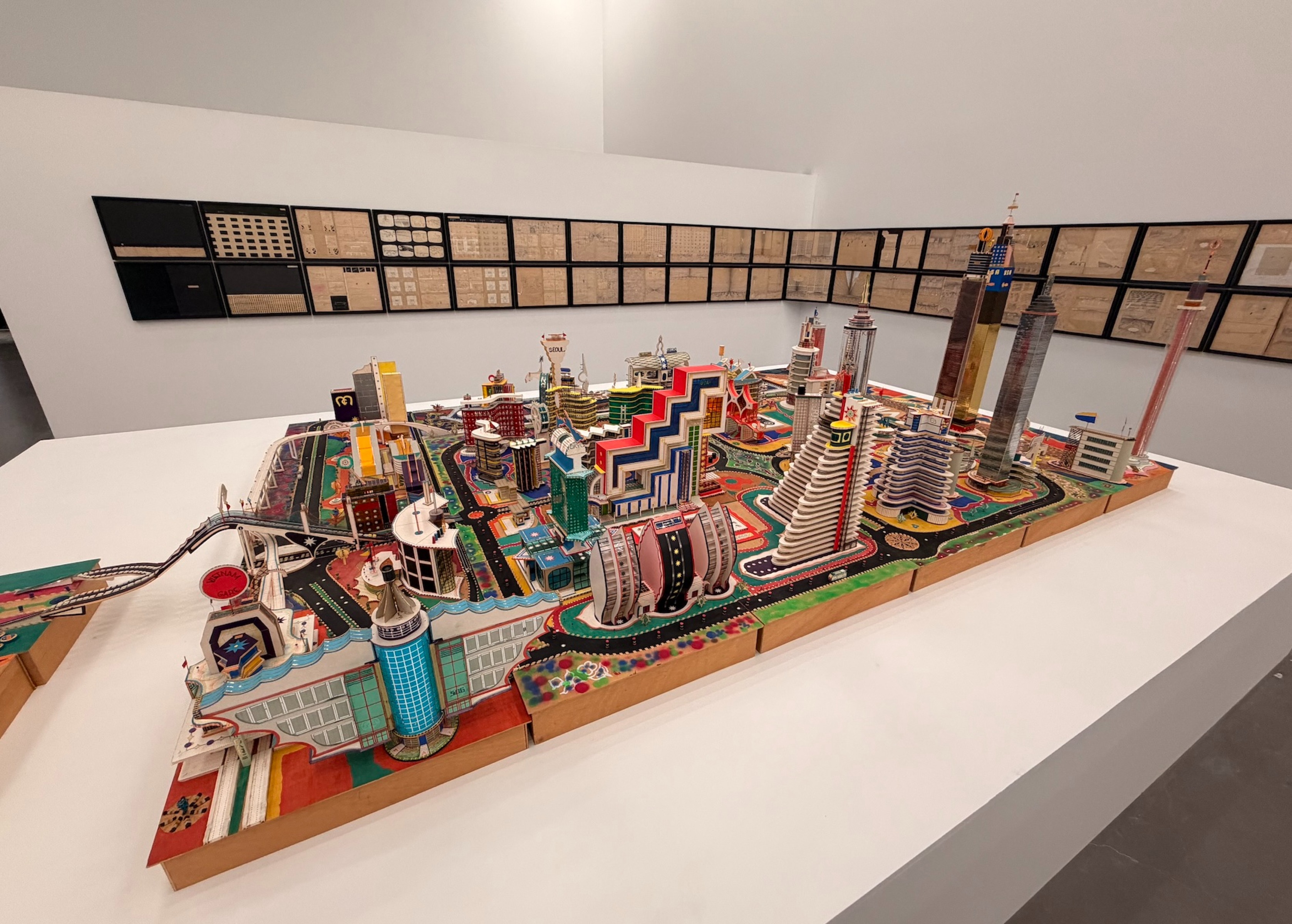
Bodys Isek Kingelez, “Villa fantome (Ghost town)” (1996)
NEW INC, the museum-led creative incubator, now has a permanent home in the new building. What does it mean for the future of the New Museum to have artists and entrepreneurs literally embedded in the building?
Not many people know that NEW INC had its first home in the original building that stood where now the expansion sits. The New Museum acquired the building back in 2008 and gradually we started occupying it with our offices, archives, exhibition spaces, studios for artists, and NEW INC itself. So yes, now NEW INC has a dedicated space, but it was there from the start. I think it’s important to emphasize this aspect because it also explains the necessity of this expansion: this new building is not a vanity project, it came with very specific goals and it expresses, and solves, very specific needs. Again, I think this is something to keep in mind because it explains how this expansion is very much rooted in our history and it is addressing actual necessities.
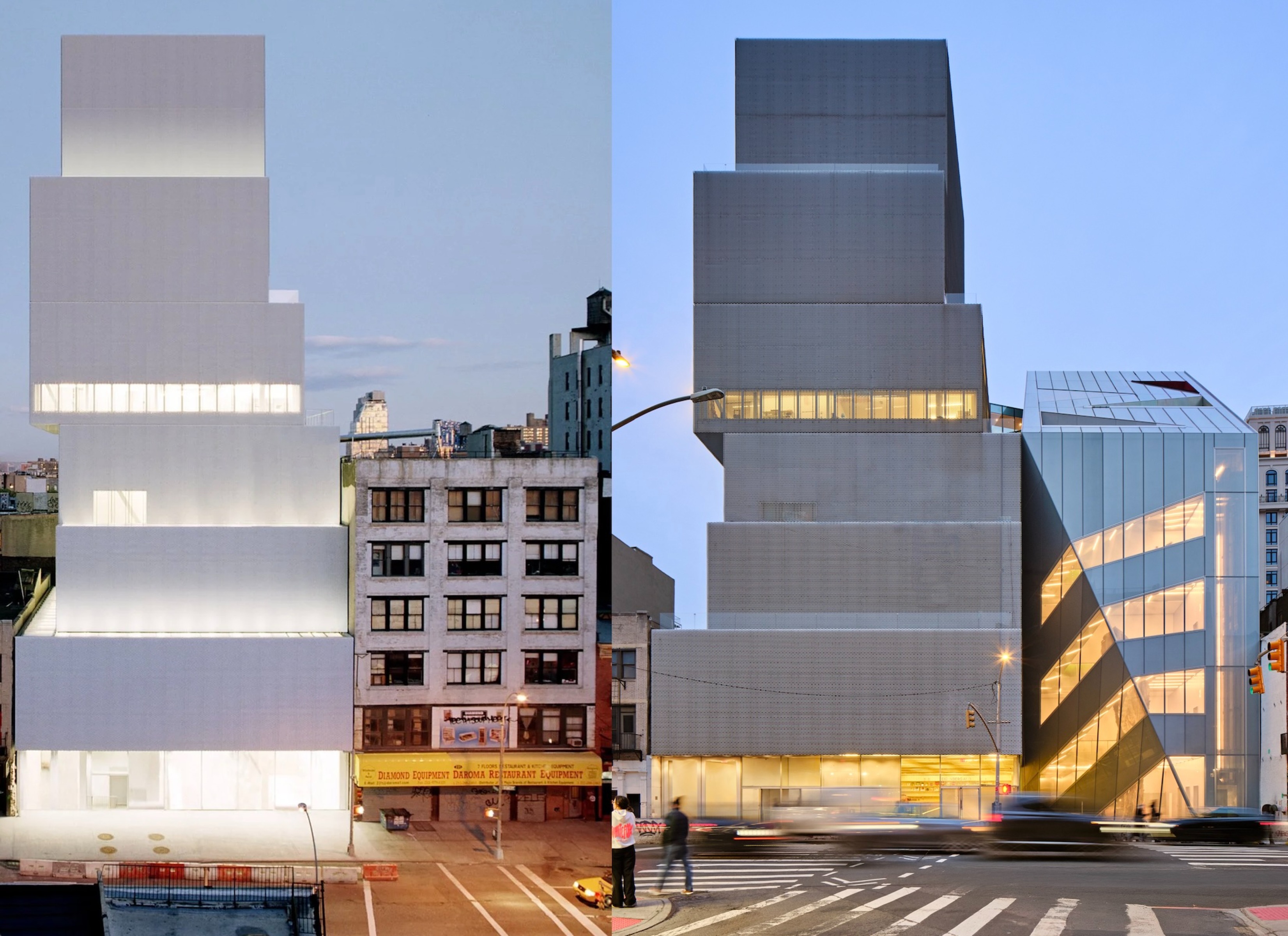
The New Museum before (left) and after (right) Tony Devan Lewis Building expansion
What are you most excited about for the year ahead? Anything that you think people aren’t talking about enough yet?
We are right in the middle of the first few weeks of opening to the public and it is so exciting to see the audiences navigating the spaces. It was so wonderful to see how much time visitors are spending in the galleries: it is a dense, rich show, extremely researched but also, I think, very entertaining and one that rewards attention and engagement, so it was amazing to see how our public is spending time in the galleries, more than ever before, learning but also being swept away by an exhibition that has many parts, many moving parts at that, which are also very spectacular. I just love seeing also how much children are into our robots, from the automated mouse by Ryan Gander to the flying vehicles and kinetic works by Meriem Bennani and Bruce Lacey.
Having said all this, there is also so much that goes on behind closed doors. A lot of this work actually started while we were closed to the public: we work in public housing in our neighborhood, giving art classes for children; we have 100 teenagers on site learning about art and museums and artists; we offer mentorship to young artists and creatives through NEW INC. While we are an extremely international museum. There are artists from 56 countries in this first show, we are intimately connected with our neighborhood and NYC: this is another defining aspect of who we are, one that maybe is less visible but as equally important.
The New Museum has always championed living artists and challenged what a museum can be. With double the space, how does this expansion change what’s now possible?
I think you can see it in this inaugural show and its surrounding program. We are a museum that privileges production over preservation, after all, I always say that the museum was the site of the muses who were the daughters of Mnemosyne, the goddess of memory, and Zeus, the god of creation: museums are not just places of memory but also site of production.
So we invest a lot of energy and resources in producing new works and supporting artists in realizing new commissions. Aside from New Humans, that features more than 15 new commissions realized appositely for the show, we also commissioned major new pieces by Tschabalala Self, for our facade, Klara Hosnedlova, for the ATRIUM STAIR, and Sarah Lucas, whose sculpture will debut in our plaza in a couple of months. All our new productions remain in the possession of the artist after we show them. Since we don’t have a collection, we believe our responsibility is to participate in the creation and distribution of art, not in its accumulation, and this results in many of our works to travel the world and have a second life after they leave the New Museum.
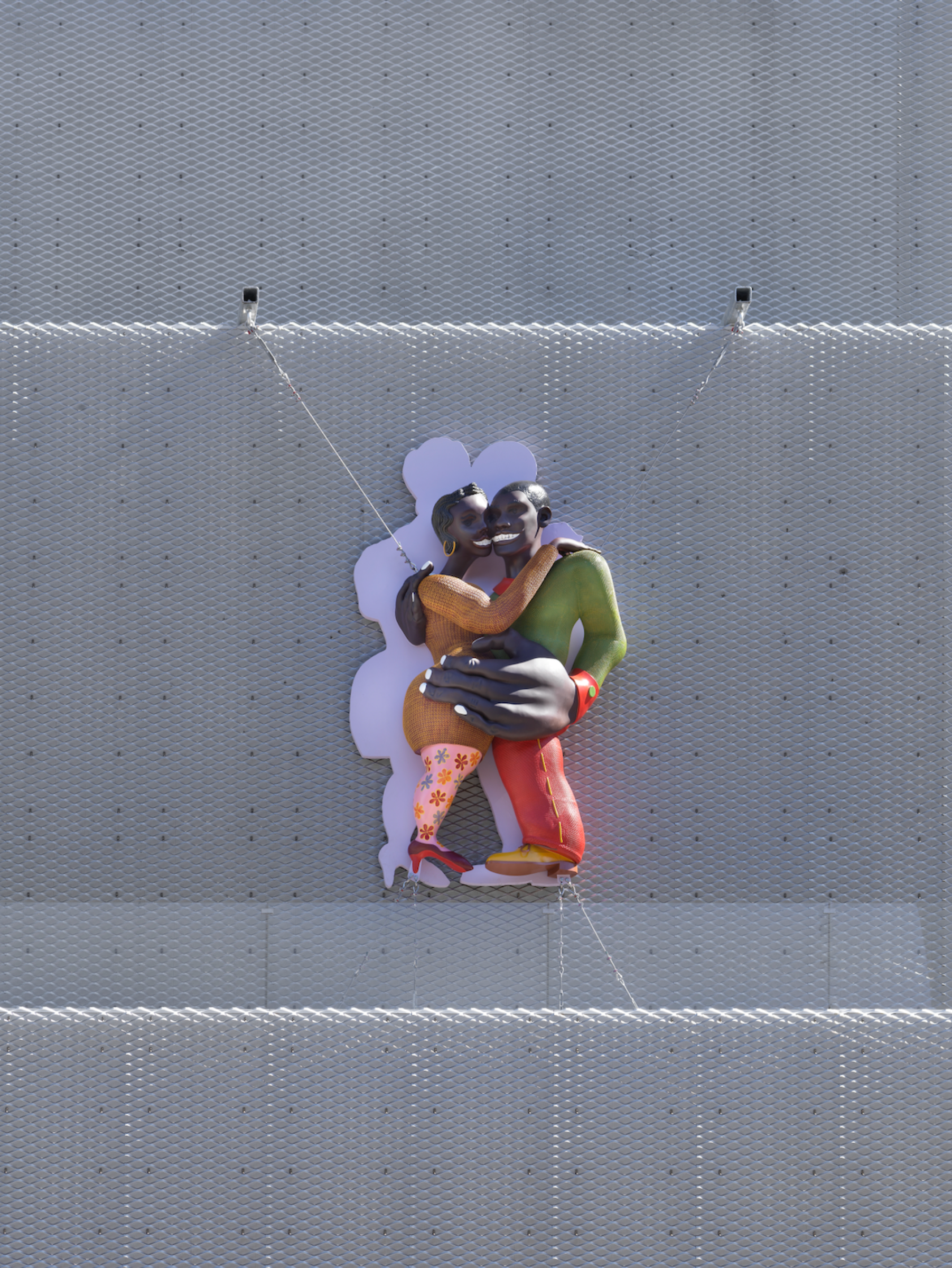
Tschabalala Self “Art Lovers” (2025) Photo by Dario Lasagni, Courtesy New Museum
Additionally, just because we don’t have a collection, we can always revisit the past, as we do in New Humans; from the perspective of the present and the future: just as we think of the New Museum as the place where to see the art of tomorrow today, we also think of our institution as a site where one can deconstruct and reconstruct the past from our vantage point. We understand history also as a process of constant questioning and rediscovery.
“New Humans: Memories of the Future” is on view now at the New Museum, 235 Bowery, New York. They’re open Tuesday through Sunday, with pay-what-you-wish hours on Thursday evenings.